
Transcription & Translation
RNA polymerase reads DNA; ribosomes build proteins.
The central dogma
DNA → RNA → protein. Transcription copies a gene from DNA into mRNA in the nucleus; translation reads mRNA at a ribosome to assemble a polypeptide. Reverse transcription (RNA → DNA, used by retroviruses like HIV) is the famous exception.
Transcription
RNA polymerase II binds the promoter region (helped by transcription factors at the TATA box in eukaryotes), unwinds the DNA, and reads the template strand 3' → 5', synthesizing pre-mRNA 5' → 3'. RNA uses U instead of T.
In eukaryotes, the pre-mRNA is processed before leaving the nucleus: a 5' methylated cap is added (helps the ribosome bind, protects from degradation), a poly-A tail is added at the 3' end (also protective and aids export), and introns are spliced out by the spliceosome — only exons remain in the mature mRNA.
Alternative splicing
By including or excluding different combinations of exons, a single pre-mRNA can produce many different mature mRNAs, and therefore many different proteins. This is one big reason humans (~20,000 genes) can make hundreds of thousands of distinct proteins.
Translation
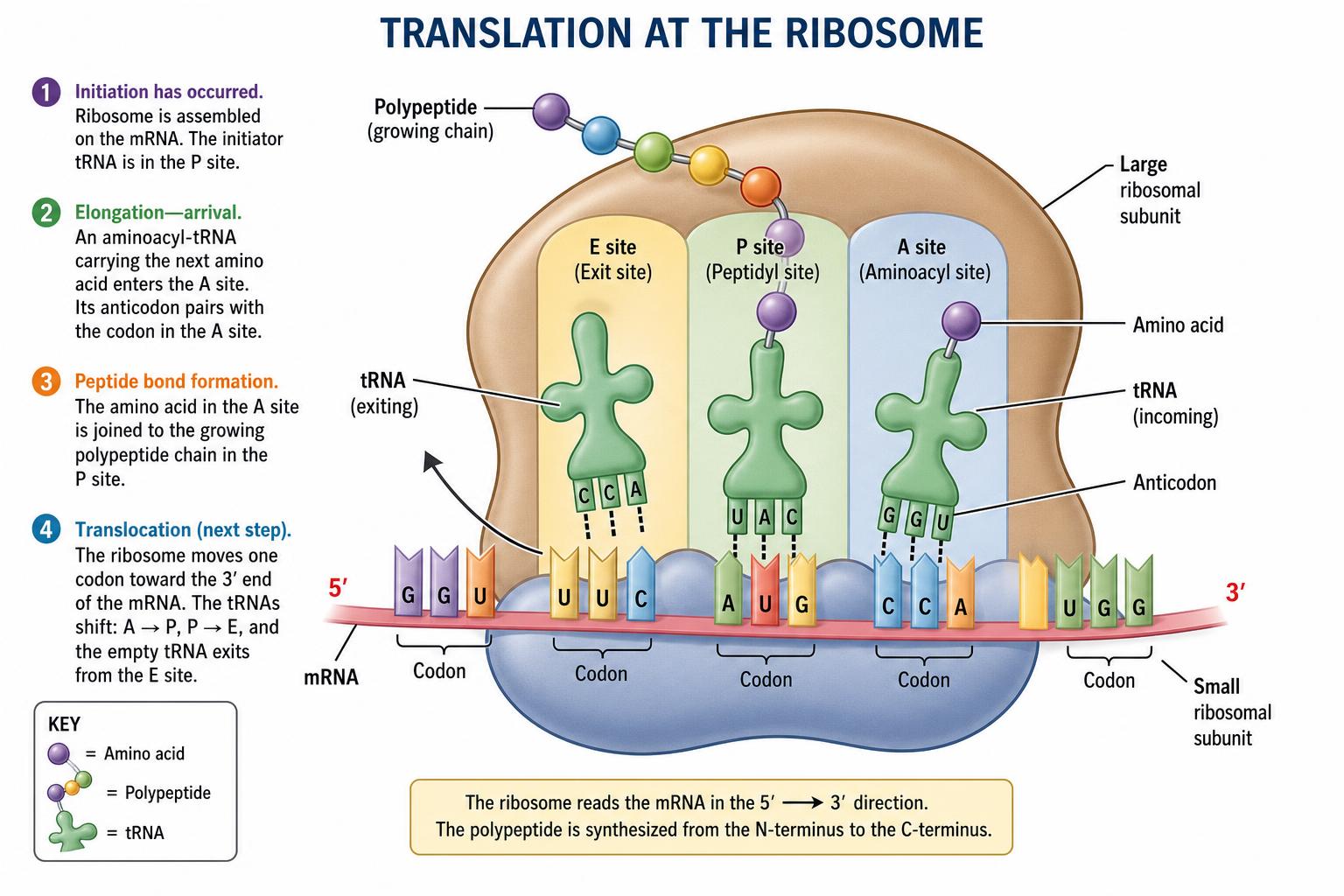
Ribosomes read mRNA in 3-nucleotide codons. The small ribosomal subunit binds mRNA and starts at the start codon AUG (which also codes for methionine). The large subunit then joins, forming three tRNA binding sites: A (incoming aminoacyl-tRNA), P (peptidyl-tRNA holding the growing chain), and E (exit).
Each tRNA has an anticodon that pairs with the mRNA codon and carries the correct amino acid. As the ribosome translocates one codon at a time, peptide bonds form between adjacent amino acids until a stop codon (UAA, UAG, UGA) releases the finished polypeptide.
Post-translational modification
After translation, proteins are often cut, folded with the help of chaperones, sent to the right compartment via signal peptides, or modified by adding sugars (glycosylation), phosphate groups, lipids, or by clipping off pieces (e.g., insulin is cut from a larger precursor proinsulin).
Key terms
Quick definitions to lock in before the exam.