
DNA & RNA Structure / Replication
Semiconservative replication preserves the genome.
Semiconservative replication
Each new DNA double helix contains one parental (old) strand and one newly synthesized strand. The Meselson-Stahl experiment proved this elegantly using ¹⁵N → ¹⁴N labeling and density-gradient centrifugation.
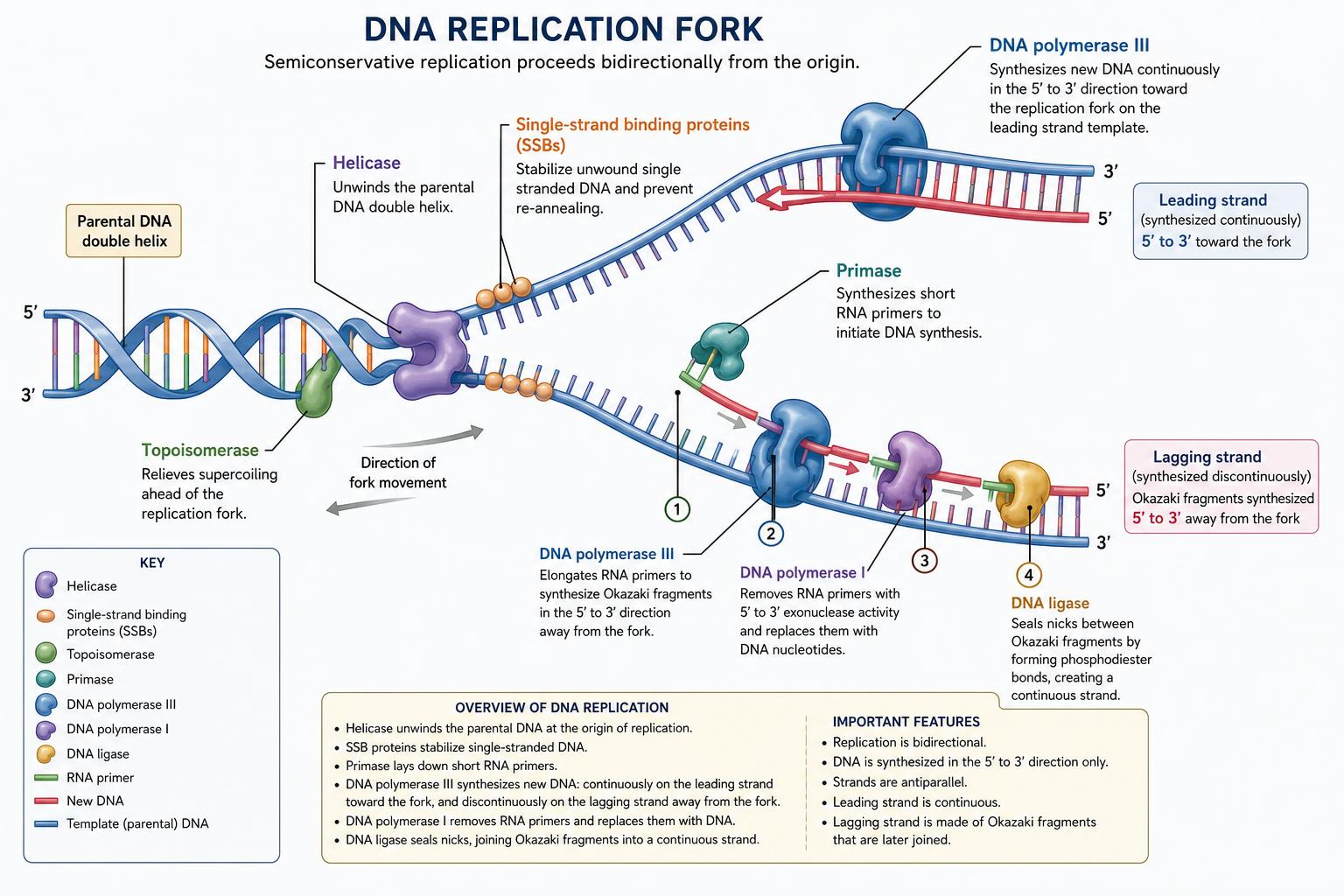
Players at the replication fork
- Helicase: unwinds the double helix at the origin of replication, forming a replication fork.
- Single-strand binding proteins: keep separated strands from re-annealing.
- Topoisomerase: relieves the supercoiling tension ahead of the fork.
- Primase: lays a short RNA primer providing a free 3' OH.
- DNA polymerase III: synthesizes the new strand 5' → 3', adding nucleotides to the 3' end.
- DNA polymerase I: replaces RNA primers with DNA.
- DNA ligase: seals the gaps between Okazaki fragments.
Leading vs. lagging strand
DNA polymerase can only synthesize 5' → 3'. Because the two parental strands are antiparallel, one new strand (the leading strand) can be synthesized continuously toward the fork. The other (the lagging strand) must be made in short pieces called Okazaki fragments, each started by its own primer and later sewn together by ligase.
Proofreading and telomeres
DNA polymerase has a built-in proofreading function — if it inserts a wrong base, it can back up and remove it. Combined with separate mismatch repair, this brings the error rate down to about 1 in a billion bases.
Linear eukaryotic chromosomes lose a bit at the ends with every round of replication (the end-replication problem). Telomeres — repetitive non-coding DNA — act as buffers that get shortened instead of important genes. Telomerase, active in stem cells and germ cells, can extend them.
Key terms
Quick definitions to lock in before the exam.