
Gene Regulation
Operons in prokaryotes; transcription factors and epigenetics in eukaryotes.
Why cells regulate gene expression
Every cell in your body carries the same DNA, yet a neuron, a liver cell, and a muscle cell look and behave nothing alike. The difference is which genes are expressed when. Bacteria likewise turn genes on only when their products are needed — making proteins costs energy and resources.
Prokaryotic operons
An operon is a cluster of functionally related genes under a single promoter, regulated as a unit. Operons let bacteria respond fast to changing environments.
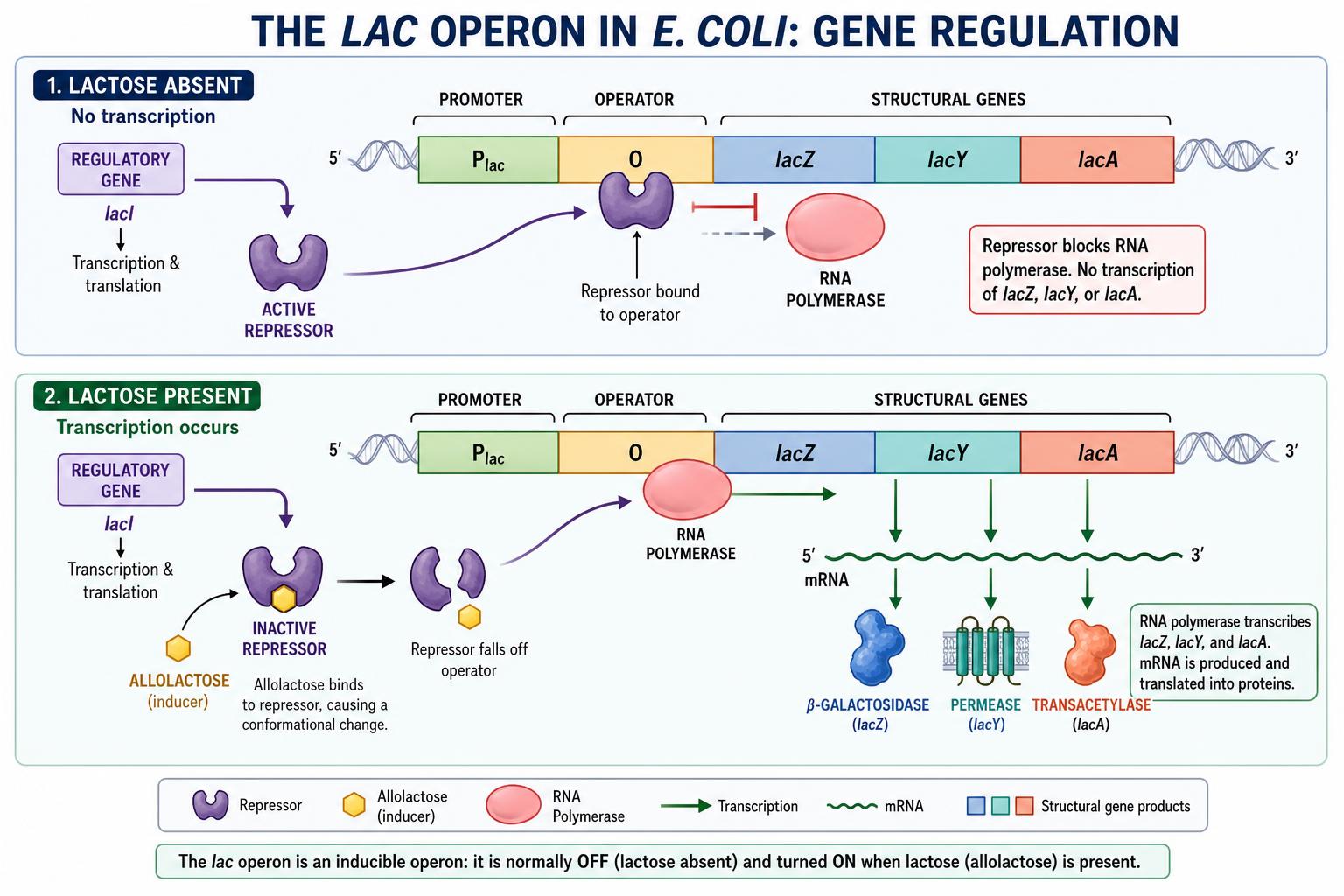
The lac operon (inducible) is OFF by default. When lactose is present, it binds the lac repressor and inactivates it, allowing RNA polymerase to transcribe the genes that digest lactose. The trp operon (repressible) is ON by default and makes tryptophan; when tryptophan accumulates, it binds the repressor and activates it, shutting the operon off.
Eukaryotic regulation: many more layers
Eukaryotes regulate genes at every step: chromatin structure → transcription → RNA processing → mRNA stability and transport → translation → protein modification and degradation.
Specific transcription factors bind to promoter and enhancer sequences to recruit RNA polymerase. Enhancers can be thousands of bases away from the gene; DNA loops to bring them into contact.
Chromatin modifications & epigenetics
- Histone acetylation: weakens histone–DNA contact → chromatin loosens → genes more accessible → MORE transcription.
- DNA methylation (adding -CH₃ to cytosines): usually compacts chromatin and silences genes; methylation patterns can be inherited.
- These changes don't alter the DNA sequence but can be passed to daughter cells (and sometimes offspring) — that's epigenetics.
Post-transcriptional control
Alternative splicing creates multiple proteins from one gene. miRNAs and siRNAs bind complementary mRNA sequences and trigger destruction or block translation, providing another fast off-switch.
Key terms
Quick definitions to lock in before the exam.