
Community Ecology
Species interactions shape community structure.
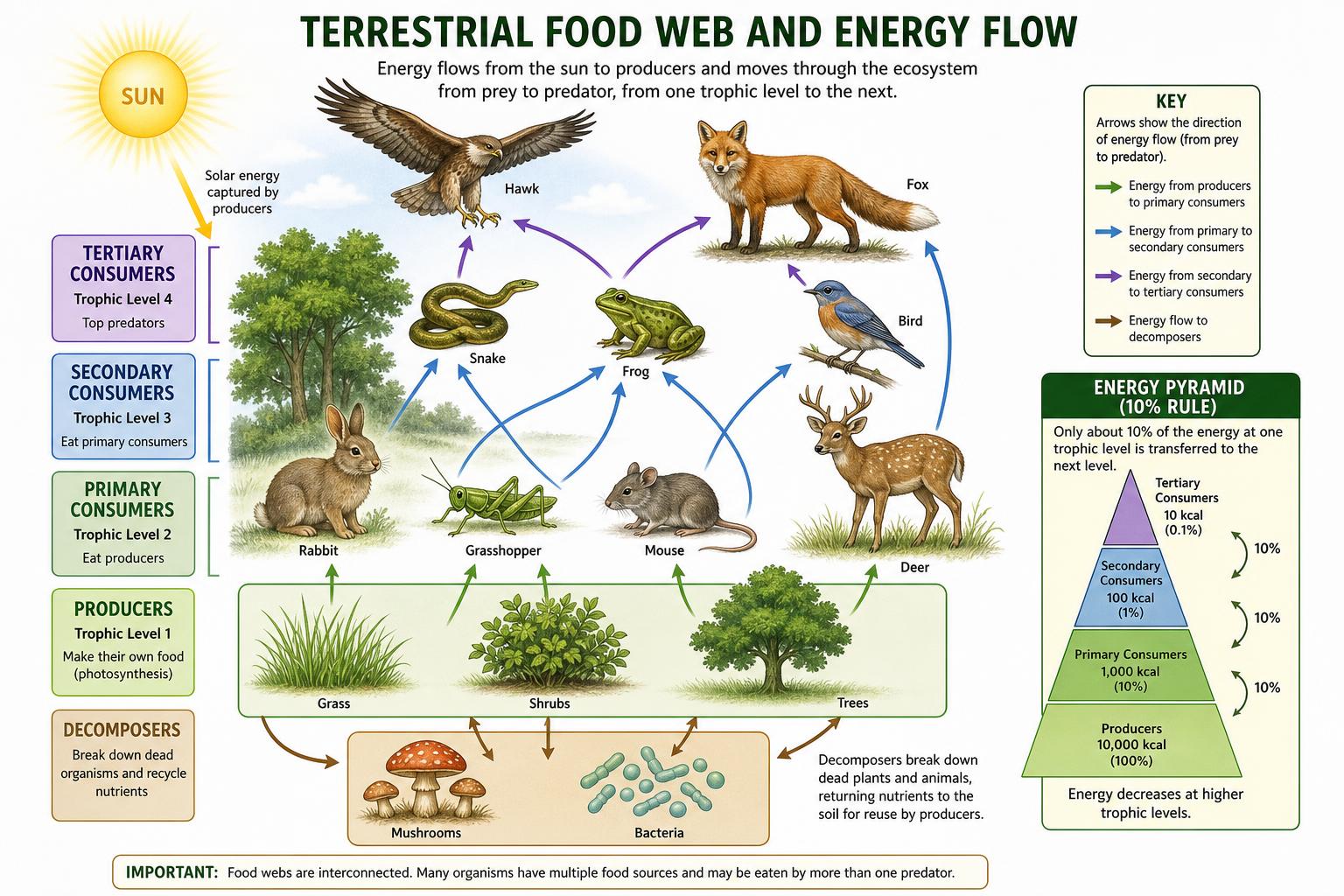
Species interactions
- Competition (–/–): both species are harmed; intraspecific competition (same species) is usually fiercest.
- Predation & herbivory (+/–): predator/herbivore benefits, prey/plant is harmed. Drives coevolution (cheetah speed vs. gazelle speed).
- Mutualism (+/+): both benefit (bees & flowers, mycorrhizae & plant roots, gut bacteria & us).
- Commensalism (+/0): one benefits, the other is unaffected (barnacles riding a whale).
- Parasitism (+/–): a special long-term predation (ticks, tapeworms, parasitic wasps).
Niches & competitive exclusion
A species' niche is its full ecological role: what it eats, where it lives, when it's active, how it reproduces. The competitive exclusion principle says two species with identical niches cannot coexist long term — one will outcompete and eliminate the other.
In real ecosystems, similar species often coexist via resource partitioning, using slightly different parts of the same resource (different beak sizes for different seed sizes, foraging at different times of day, using different parts of the same tree).
Keystone species
Some species have effects on their community far out of proportion to their abundance. Sea otters keep sea urchin populations in check, which keeps kelp forests alive, which support hundreds of other species. Wolves reintroduced to Yellowstone reduced elk overgrazing, allowing willows and aspens to recover, which brought back beavers and songbirds — a textbook trophic cascade.
Ecological succession
Primary succession starts from scratch on bare rock (after a volcanic eruption or glacial retreat). Pioneer species (lichens, mosses) break down rock to make the first thin soil. Over decades to centuries, grasses, shrubs, and finally trees move in.
Secondary succession happens after a disturbance (fire, flood, abandonment of farmland) that leaves soil intact. It's much faster because soil and seeds are already in place — abandoned fields can become forests in 50–150 years.
Key terms
Quick definitions to lock in before the exam.