
Photosynthesis
Light energy → chemical energy stored in glucose.
The big picture
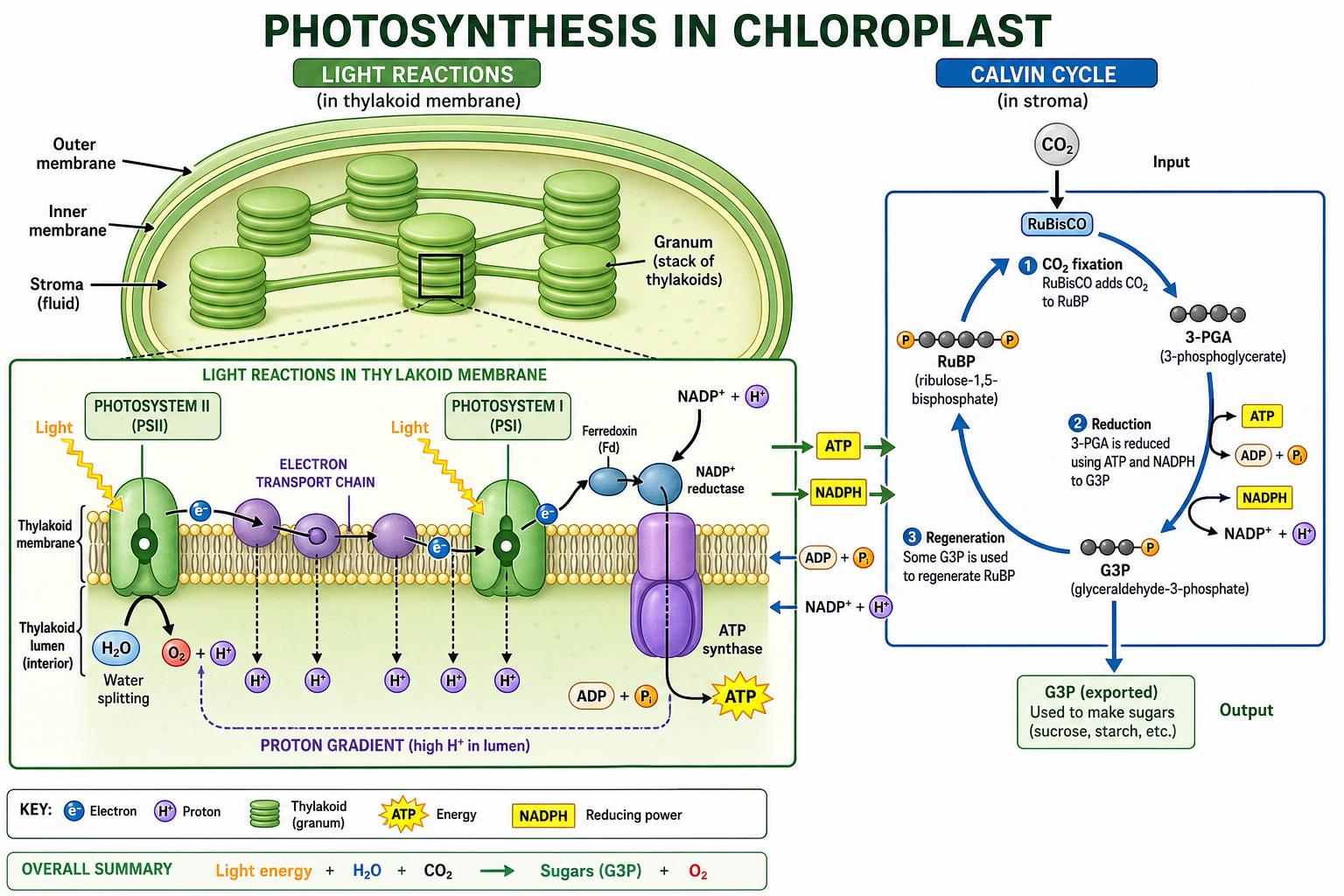
Photosynthesis converts light energy into the chemical energy of glucose. Overall: 6 CO₂ + 6 H₂O + light → C₆H₁₂O₆ + 6 O₂. The oxygen released comes from H₂O, not CO₂ — a fact you should be able to defend with isotope-labeling experiments.
Two linked stages: the light reactions (thylakoid membrane) convert light into ATP and NADPH; the Calvin cycle (stroma) uses that ATP and NADPH to build sugar from CO₂.
Light reactions — the thylakoid membrane
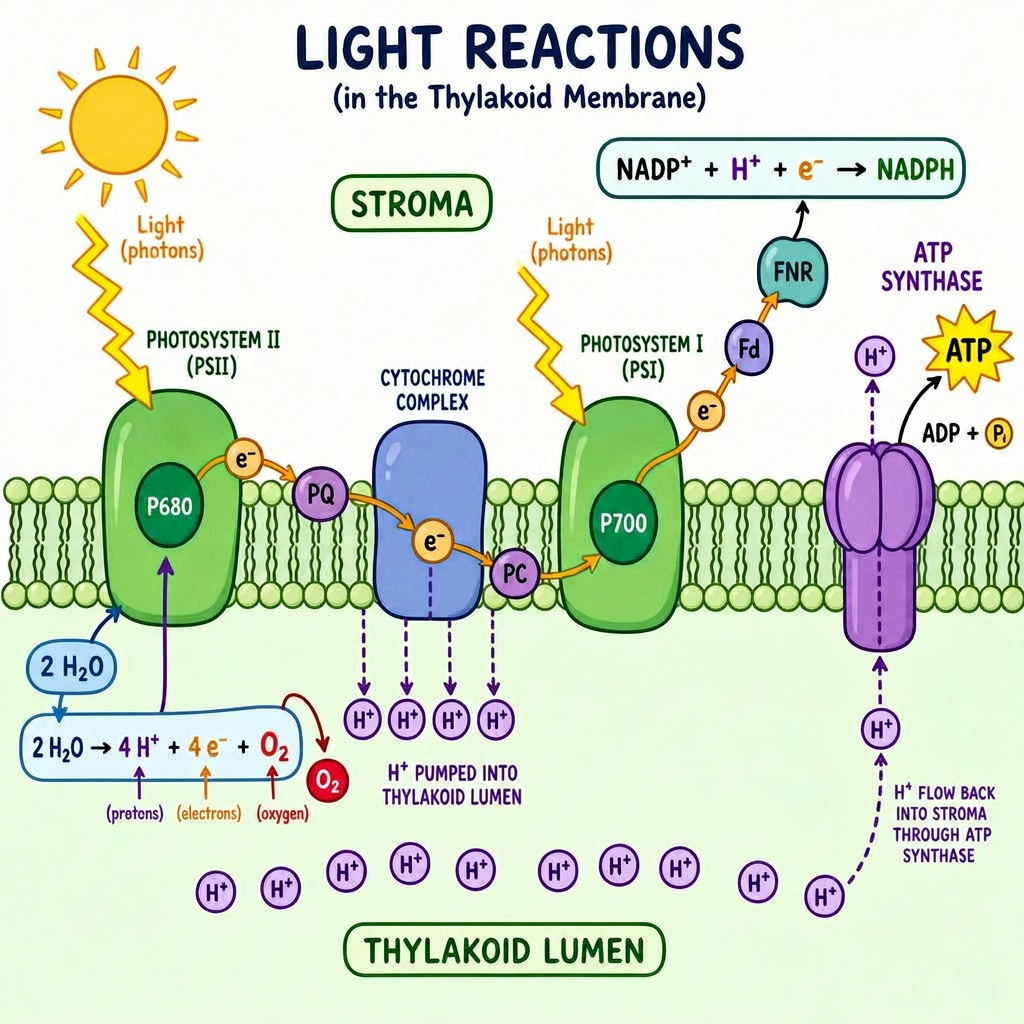
Pigments (chlorophyll a, chlorophyll b, carotenoids) in PSII absorb photons. The energy excites an electron, which is passed down an electron transport chain to PSI. PSI absorbs more light and boosts the electron's energy again to reduce NADP⁺ → NADPH.
Each time PSII loses an electron, it grabs a replacement by splitting water: 2 H₂O → 4 H⁺ + 4 e⁻ + O₂. This is the source of atmospheric oxygen and of the H⁺ that builds up inside the thylakoid lumen.
As electrons travel the ETC, the proton pump shoves H⁺ from the stroma into the thylakoid lumen. H⁺ then flows back out through ATP synthase, driving photophosphorylation (chemiosmosis) to make ATP.
Calvin cycle — fixing carbon
Runs in the stroma. Three phases:
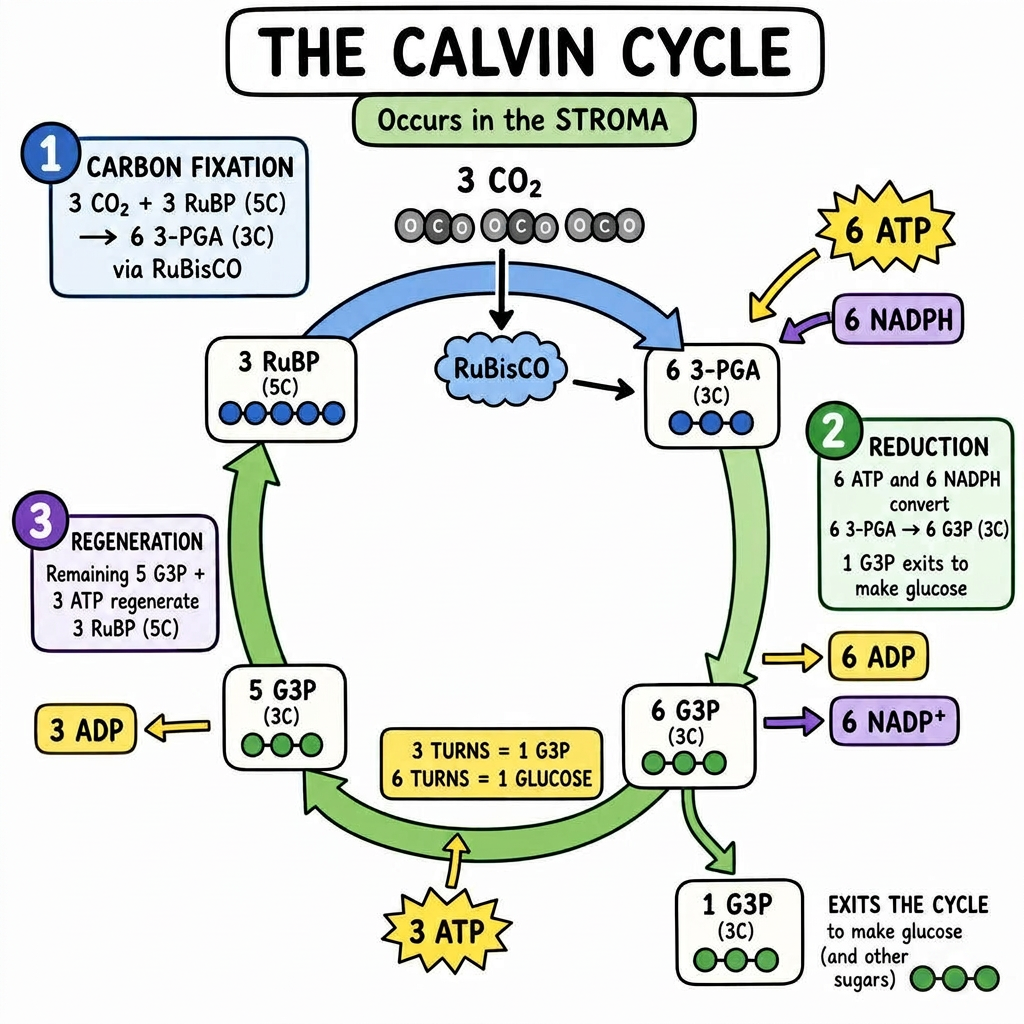
- 1. Fixation — RuBisCO attaches CO₂ to RuBP (5C), making an unstable 6C intermediate that splits into 2 molecules of 3-PGA (3C).
- 2. Reduction — ATP and NADPH from the light reactions convert 3-PGA into G3P (3C). One G3P leaves to build glucose every 3 turns.
- 3. Regeneration — remaining G3P is reshuffled (using more ATP) to regenerate RuBP, keeping the cycle going.
- Stoichiometry: 3 turns fix 3 CO₂ and net 1 G3P. 6 turns and 2 G3Ps build 1 glucose.
C3, C4, and CAM plants
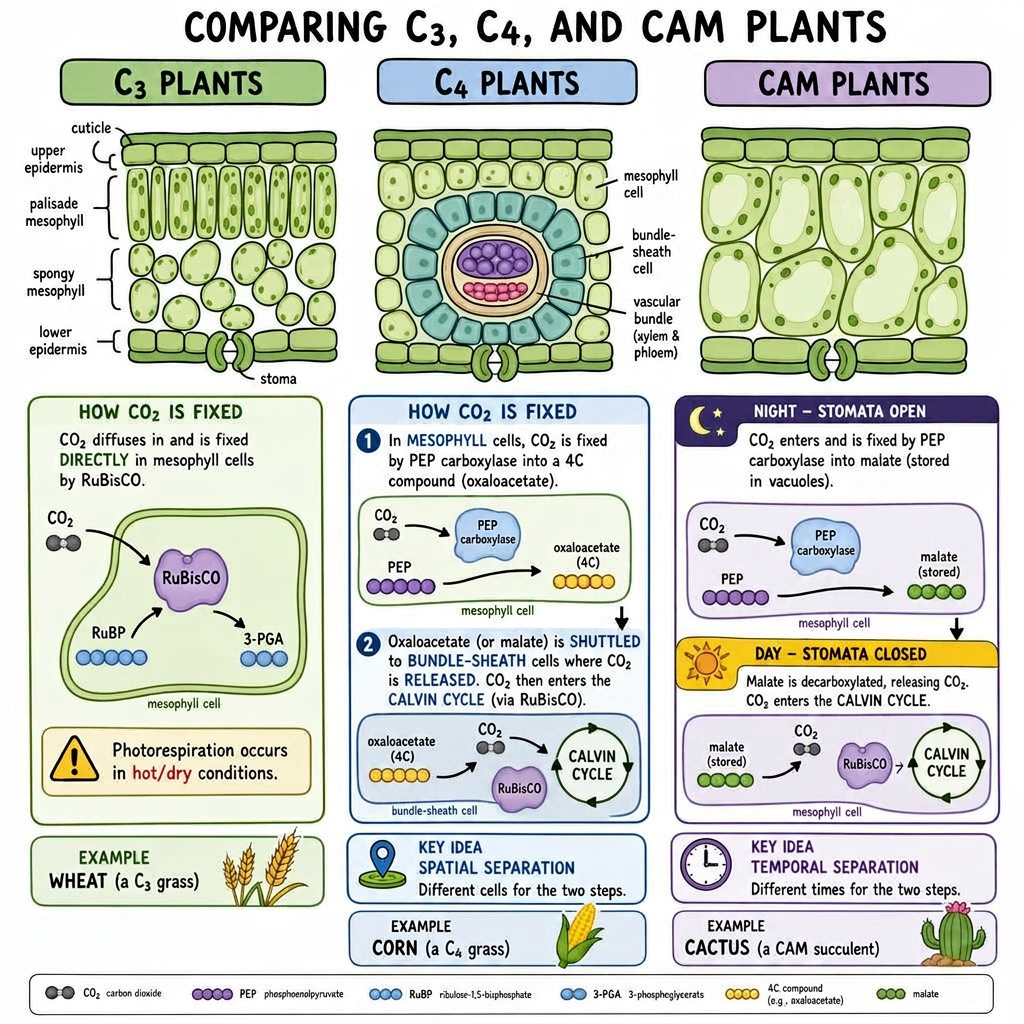
RuBisCO has a flaw: in hot, dry conditions stomata close to conserve water, O₂ builds up in the leaf, and RuBisCO sometimes binds O₂ instead of CO₂ — a wasteful process called photorespiration that produces no sugar.
C3 plants (most plants — wheat, rice) just live with it. C4 plants (corn, sugarcane) use PEP carboxylase in mesophyll cells to first fix CO₂ into a 4-carbon compound (oxaloacetate), which is shuttled to bundle-sheath cells where CO₂ is released near RuBisCO at high concentration. CAM plants (cacti, pineapple, succulents) open stomata only at night to fix CO₂, store it as malate, then run the Calvin cycle during the day with stomata closed.
Key terms
Quick definitions to lock in before the exam.