
Enzymes
Biological catalysts lower activation energy.
What enzymes do
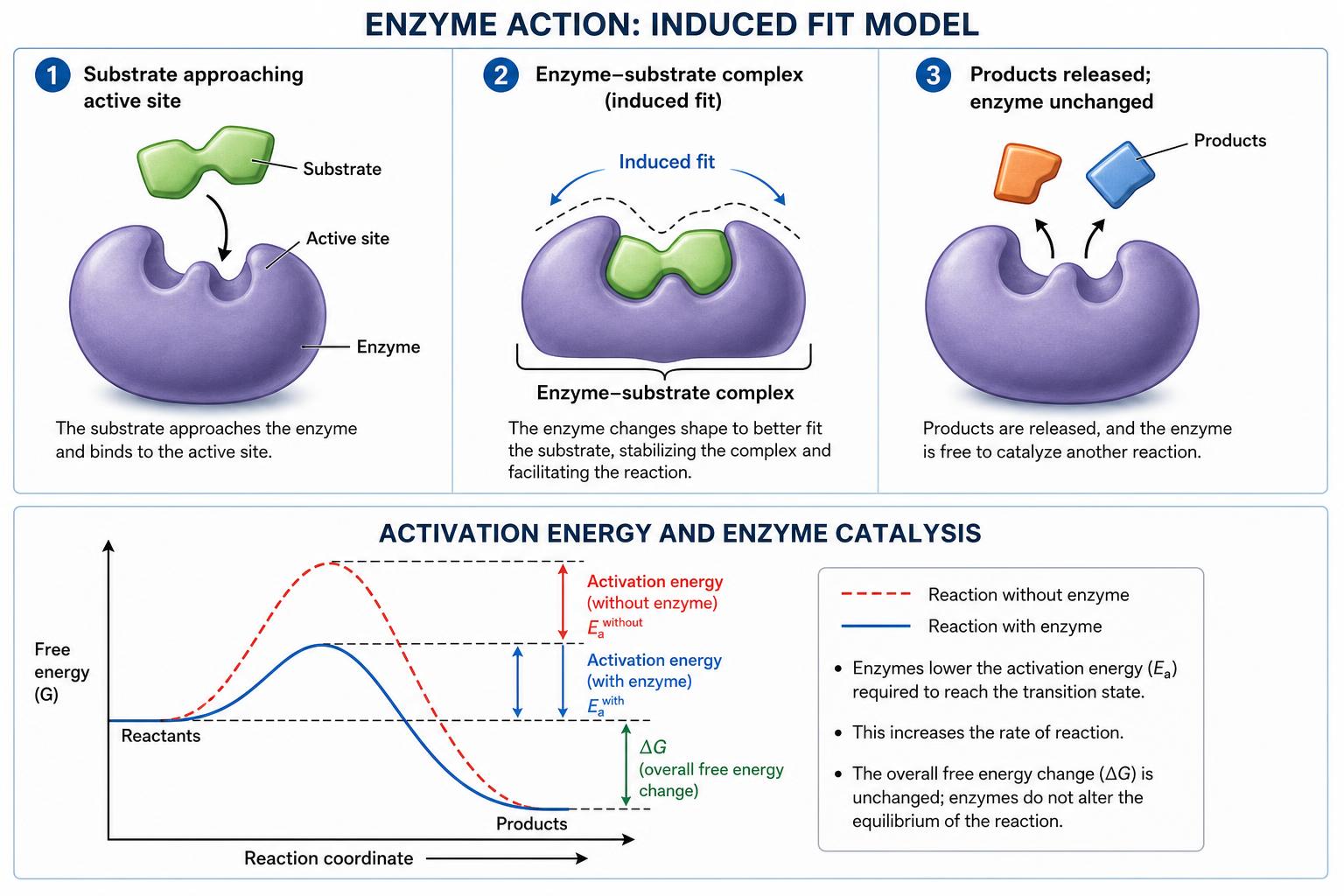
Enzymes are biological catalysts — usually proteins (a few are RNA, called ribozymes). They speed up reactions by lowering the activation energy (Eₐ) needed to push reactants over the energy barrier into products. They do NOT change the overall ΔG of the reaction, just how fast equilibrium is reached.
Enzymes are not consumed in the reaction. After releasing the products, the active site is free to bind more substrate.
Active site & induced fit
Each enzyme has a specific active site — a pocket shaped to fit one substrate (or a small family of related substrates). Modern view replaces the old 'lock and key' with induced fit: when the substrate enters, the active site flexes slightly to grip it more tightly and strain bonds in just the right way.
What changes enzyme activity
- Temperature: rate rises with temperature (more collisions) until the enzyme denatures and rate crashes. Humans peak ~37°C.
- pH: each enzyme has an optimal pH (pepsin ~2 in the stomach, trypsin ~8 in the small intestine). Far from optimum, charges on R-groups change and the active site distorts.
- Substrate concentration: rate rises with substrate until all active sites are full (saturation = Vmax).
- Enzyme concentration: more enzyme = more reaction rate, as long as there's substrate available.
Inhibitors: competitive vs. noncompetitive
A competitive inhibitor resembles the substrate and binds in the active site, blocking the real substrate. Adding more substrate can outcompete it and restore normal Vmax.
A noncompetitive (allosteric) inhibitor binds at a separate site, changing the active site's shape. Adding more substrate cannot fix this — Vmax drops.
Allosteric regulation & feedback inhibition
Many enzymes have allosteric sites where regulatory molecules can switch the enzyme on (activators) or off (inhibitors). This allows the cell to fine-tune metabolism based on current needs.
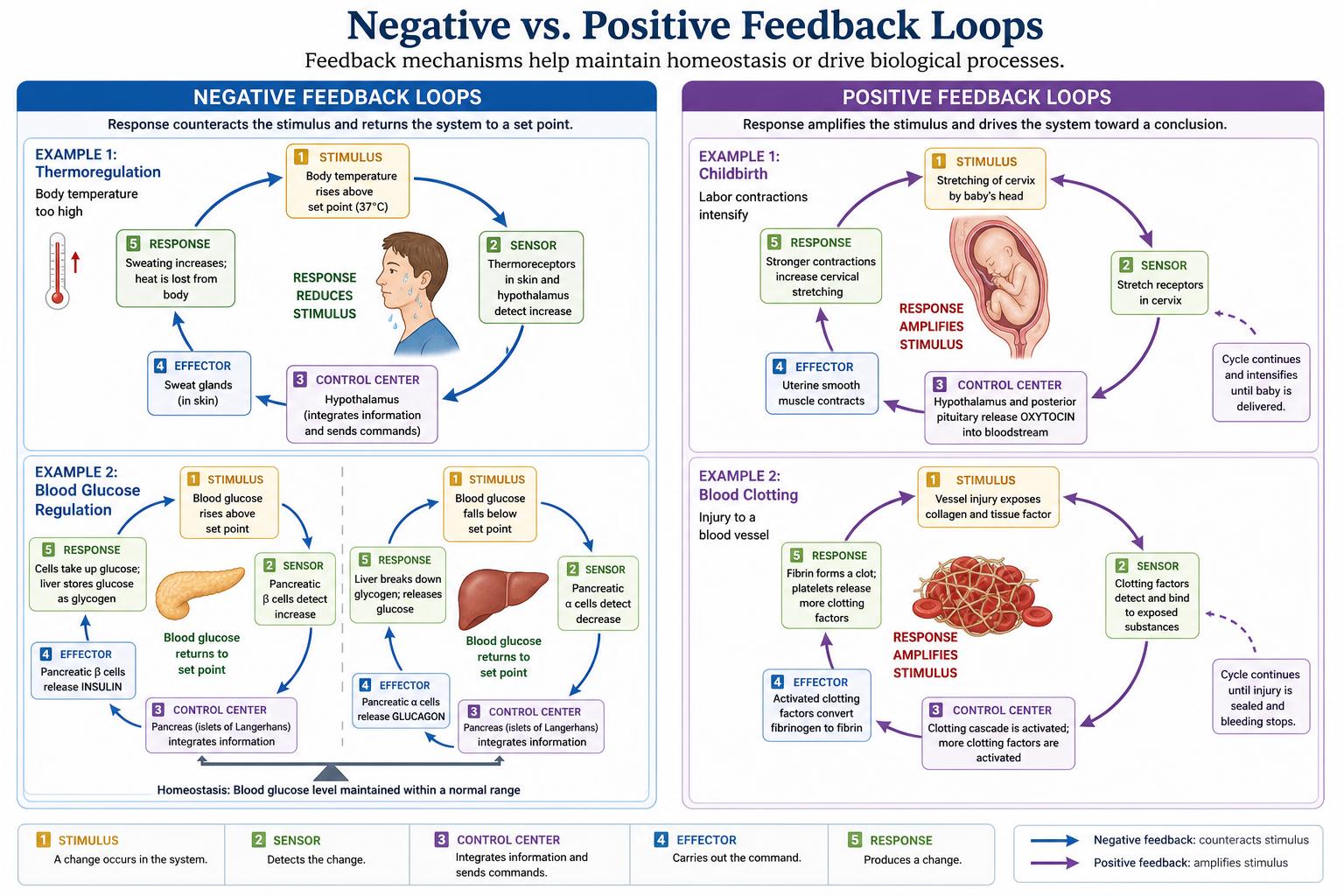
Feedback inhibition is a beautiful example: the end product of a metabolic pathway acts as an allosteric inhibitor of an enzyme earlier in the same pathway. When enough product accumulates, the pathway shuts itself down — preventing waste.
Cofactors & coenzymes
Many enzymes need help. Cofactors are inorganic helpers (Mg²⁺, Zn²⁺, Fe²⁺); coenzymes are organic helpers, often derived from vitamins (NAD⁺ from niacin, FAD from riboflavin, coenzyme A from pantothenic acid).
Key terms
Quick definitions to lock in before the exam.