
Plasma Membrane & Transport
Fluid mosaic model; selective permeability drives transport.
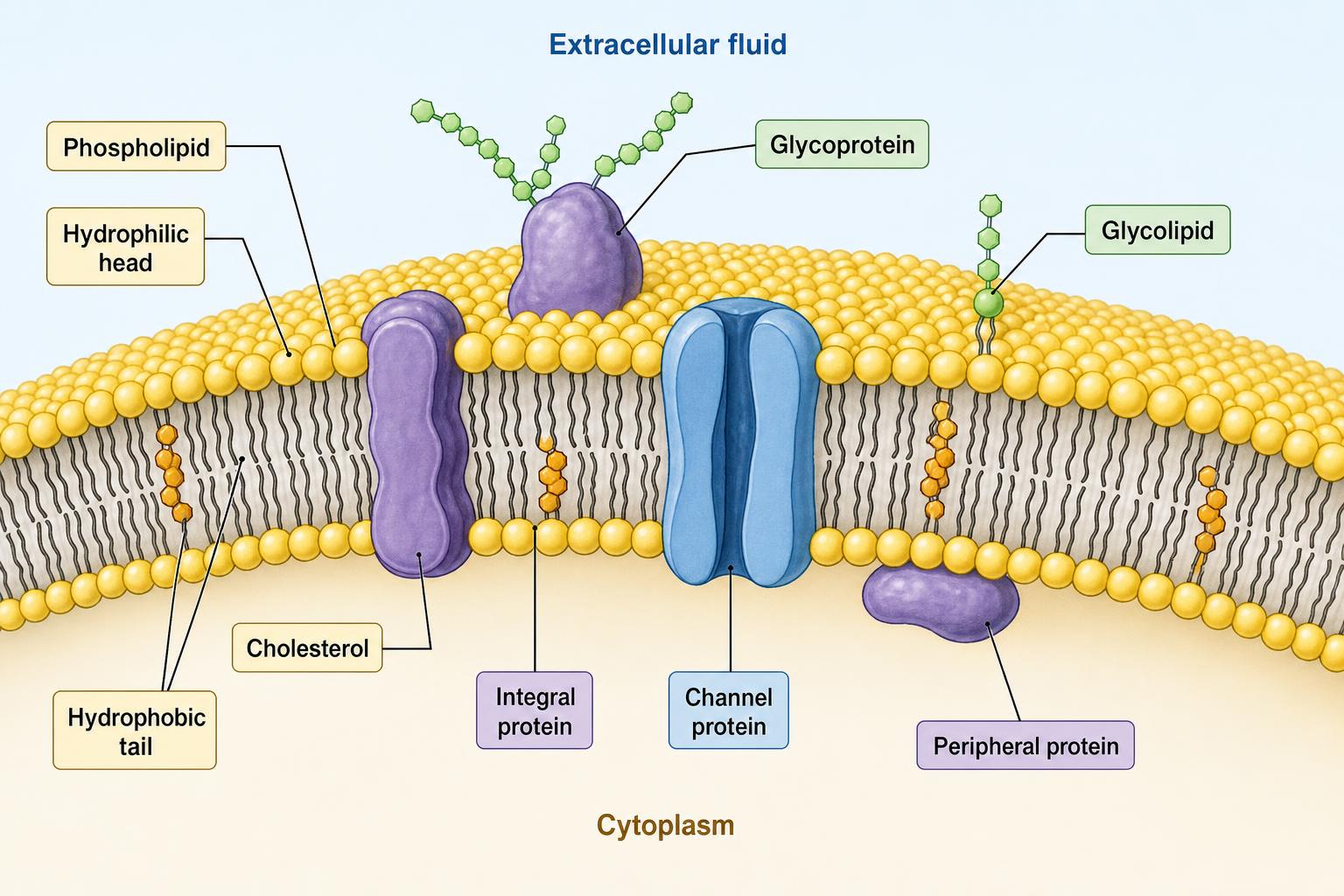
Fluid mosaic model
The plasma membrane is a phospholipid bilayer with hydrophilic heads facing the aqueous environments inside and outside the cell, and hydrophobic tails sandwiched in the middle.
Embedded in this bilayer are integral membrane proteins (channels, transporters, receptors), peripheral proteins on the surface, cholesterol molecules that buffer fluidity, and carbohydrate chains attached to lipids (glycolipids) or proteins (glycoproteins) used for cell-cell recognition.
It's called 'fluid mosaic' because the components drift laterally in the membrane like ships on the ocean — it's a dynamic surface, not a static wall.
What crosses easily — and what doesn't
The hydrophobic interior is a barrier to charged and polar molecules. Small nonpolar molecules (O₂, CO₂, steroid hormones) and very small polar molecules (H₂O, urea — slowly) can slip through directly.
Ions (Na⁺, K⁺, Ca²⁺, H⁺), large polar molecules (glucose, amino acids), and macromolecules require protein channels or transporters.
Passive transport (no ATP)
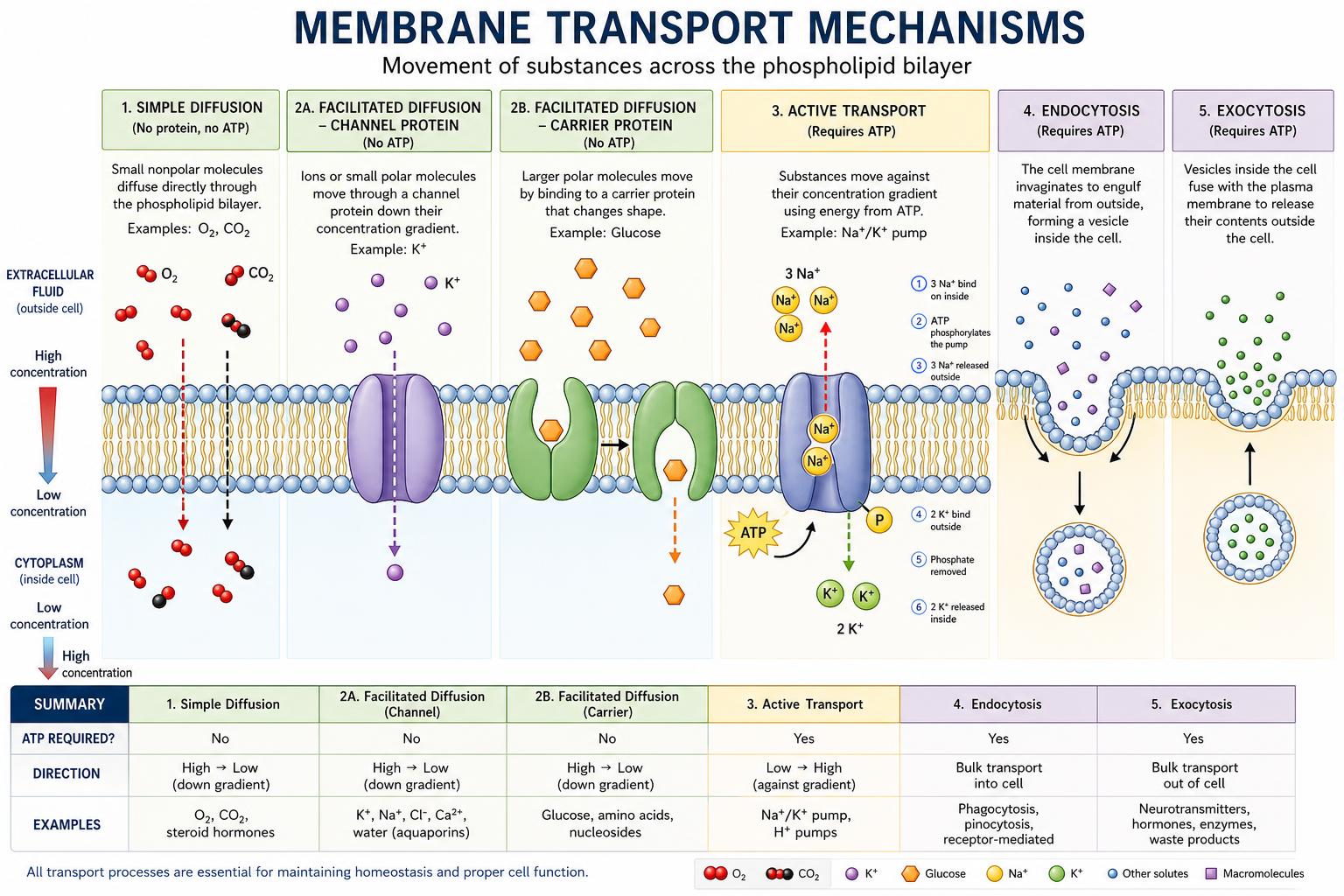
Always moves down a concentration or electrochemical gradient — from high to low. No cellular energy needed; the gradient itself is the driving force.
- Simple diffusion: small nonpolar molecules cross the bilayer directly (O₂, CO₂).
- Facilitated diffusion: polar molecules and ions move through specific channel or carrier proteins (glucose via GLUT transporters, ions via ion channels).
- Osmosis: passive diffusion of water across a selectively permeable membrane, often through aquaporins. Water moves toward the more concentrated solute side.
Active transport (requires ATP)
Moves solutes against their gradient — from low concentration to high. Requires direct or indirect energy from ATP. The classic example is the Na⁺/K⁺ pump, which pumps 3 Na⁺ out and 2 K⁺ in per ATP, building the electrochemical gradient that powers neurons and many secondary transporters.
Secondary active transport uses the gradient built by a primary pump to move a second solute — e.g., the Na⁺ gradient powers glucose uptake in the intestine via SGLT cotransporters.
Bulk transport: endocytosis & exocytosis
For very large materials (proteins, debris, whole cells), the membrane folds inward or outward, packaging cargo in vesicles.
- Phagocytosis: 'cell eating' — engulfing large particles (immune cells eating bacteria).
- Pinocytosis: 'cell drinking' — taking in small droplets of extracellular fluid.
- Receptor-mediated endocytosis: specific molecules bind receptors and are pulled in (cholesterol uptake via LDL receptors).
- Exocytosis: vesicles fuse with the plasma membrane to release contents outside (neurotransmitter release, insulin secretion).
Key terms
Quick definitions to lock in before the exam.