
Tonicity, Water Potential & Cell Origins
Water potential predicts water movement; cells originated from simpler systems.
Tonicity: comparing solute concentrations
Tonicity describes a solution relative to a cell. Hypertonic = higher solute concentration outside the cell (water leaves). Hypotonic = lower solute concentration outside (water enters). Isotonic = equal solute (no net movement).
An animal cell in a hypotonic solution swells and can burst (lysis). The same cell in a hypertonic solution shrivels (crenation). Plant cells are protected by their cell wall — they become turgid in hypotonic solutions (water fills the central vacuole and pushes against the wall) and plasmolyze in hypertonic ones (membrane pulls away from the wall).
Water potential (Ψ)
Water potential predicts which way water will move in plant systems. Water always flows from regions of HIGH water potential to LOW water potential.
Ψ = Ψs + Ψp. Solute potential (Ψs) is always ≤ 0; adding solute lowers water potential. Pressure potential (Ψp) can be positive (turgor pressure pushing out in plant cells) or negative (tension pulling water up xylem).
Surface area to volume — why cells are small
As a cell gets bigger, its volume grows much faster than its surface area (volume ~ r³, surface area ~ r²). At some point the surface area can no longer supply the volume with enough nutrients or remove waste fast enough.
Cells solve this by staying small, by folding the membrane (microvilli, cristae, thylakoids), or by becoming long and thin (neurons). Multicellularity is another solution — many small specialized cells working together.
Prokaryotes vs. eukaryotes
- Prokaryotes: no nucleus, no membrane-bound organelles, small (~1–10 µm), circular DNA, cell wall (peptidoglycan in bacteria).
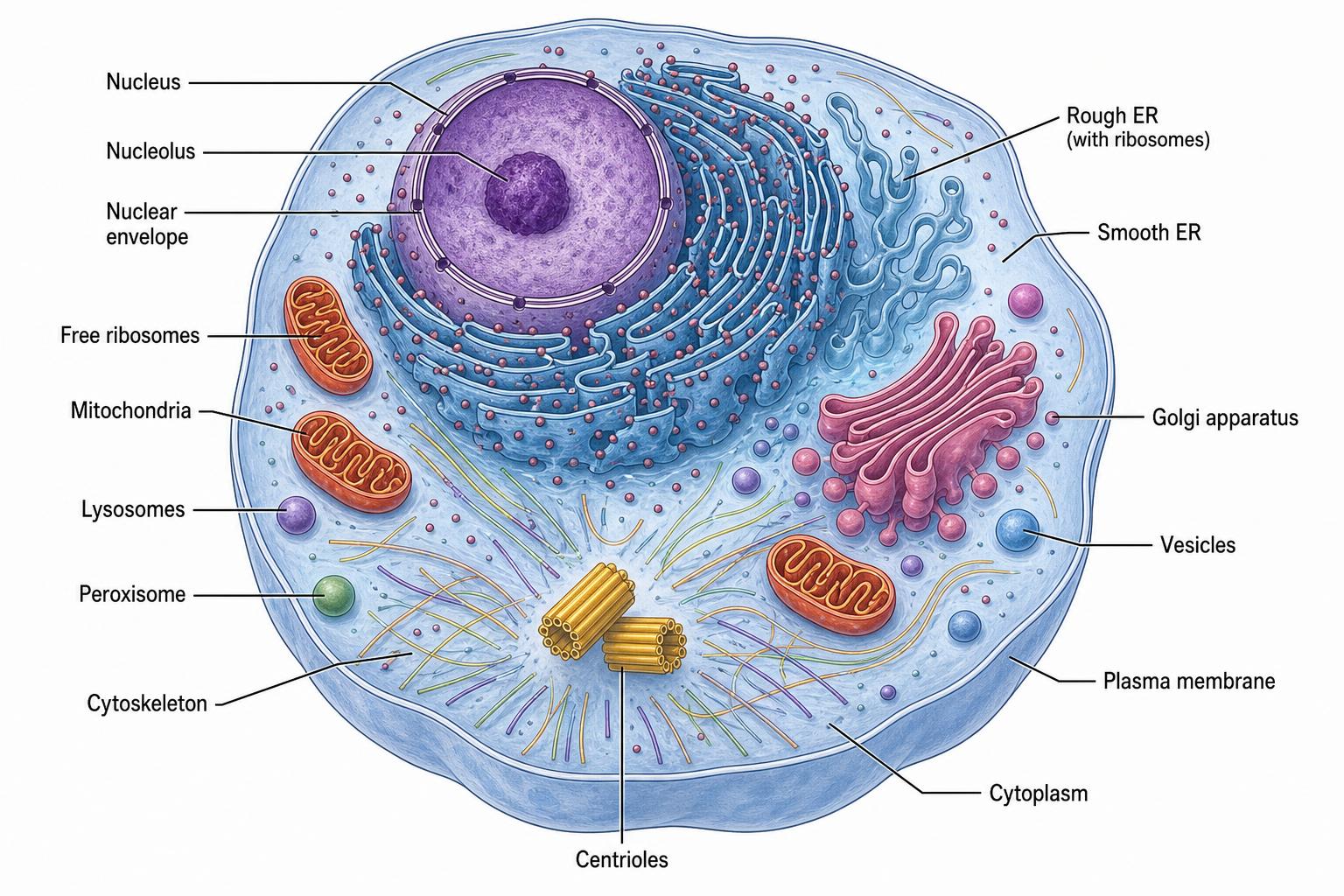
- Eukaryotes: true nucleus, membrane-bound organelles, larger (~10–100 µm), linear DNA in chromosomes, more complex cytoskeleton.
- Both: ribosomes, plasma membrane, cytoplasm, DNA.
Key terms
Quick definitions to lock in before the exam.