
Phylogeny & Evidence for Evolution
Trees, shared traits, and the fossil/molecular record.
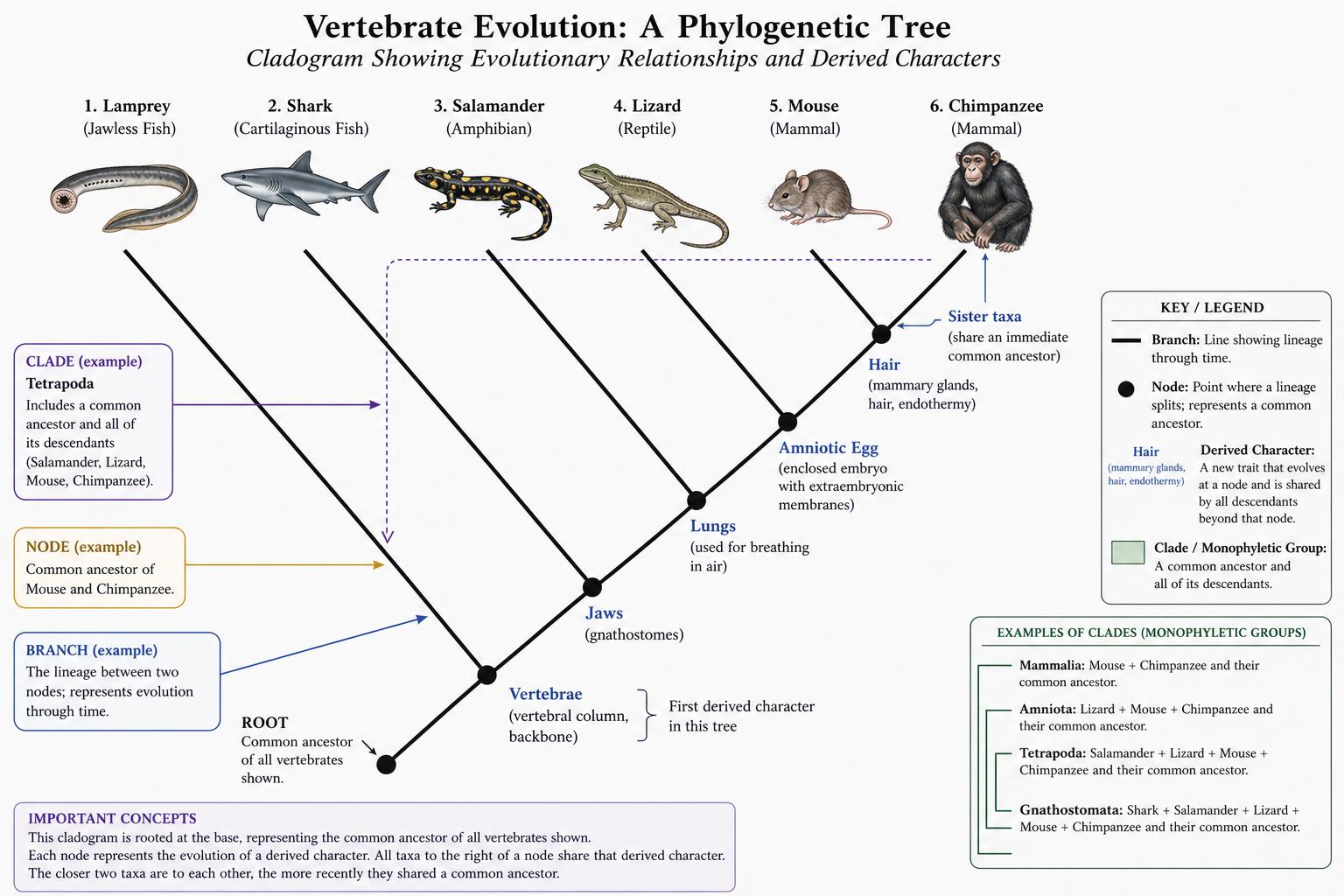
Reading phylogenetic trees
A phylogenetic tree (cladogram) shows hypothesized evolutionary relationships. Each branch point (node) represents a common ancestor. The closer two species are on the tree (fewer nodes separating them), the more recently they share a common ancestor.
Trees are built using shared derived characters (synapomorphies) — traits inherited from a common ancestor that members outside the group don't have. Rotating branches at a node doesn't change the relationships; only branching pattern matters.
Homology vs. analogy
Homologous structures share a common ancestral origin even if they now serve different functions: the bones in a human arm, a whale flipper, a bat wing, and a cat leg follow the same underlying skeletal plan. Analogous structures evolved independently for similar functions (convergent evolution): the wings of birds, bats, and insects all fly but have completely different anatomies.
Vestigial structures (human appendix, whale pelvis, ostrich wings) are leftover homologies — reduced versions of features that were once functional in an ancestor.
Multiple lines of evidence for evolution
- Fossil record: shows change over time and transitional forms (Tiktaalik between fish and tetrapods, Archaeopteryx between dinosaurs and birds).
- Anatomical: homologous structures, vestigial organs, embryonic similarity across vertebrates.
- Molecular: DNA and protein sequence similarity. The more recently two species diverged, the more similar their sequences.
- Direct observation: antibiotic resistance in bacteria, pesticide resistance in insects, Darwin's finches in real time.
- Biogeography: closely related species often live near each other (Galapagos finches differ from mainland species but resemble each other).
Molecular clocks
Some regions of DNA accumulate mutations at a roughly constant rate. By comparing sequences between two species and calibrating against known fossil dates, researchers can estimate when their lineages diverged. Faster-changing genes work for recent divergences; conserved genes work for deep evolutionary splits.
Key terms
Quick definitions to lock in before the exam.