
Hardy-Weinberg Equilibrium
Null model for a non-evolving population.
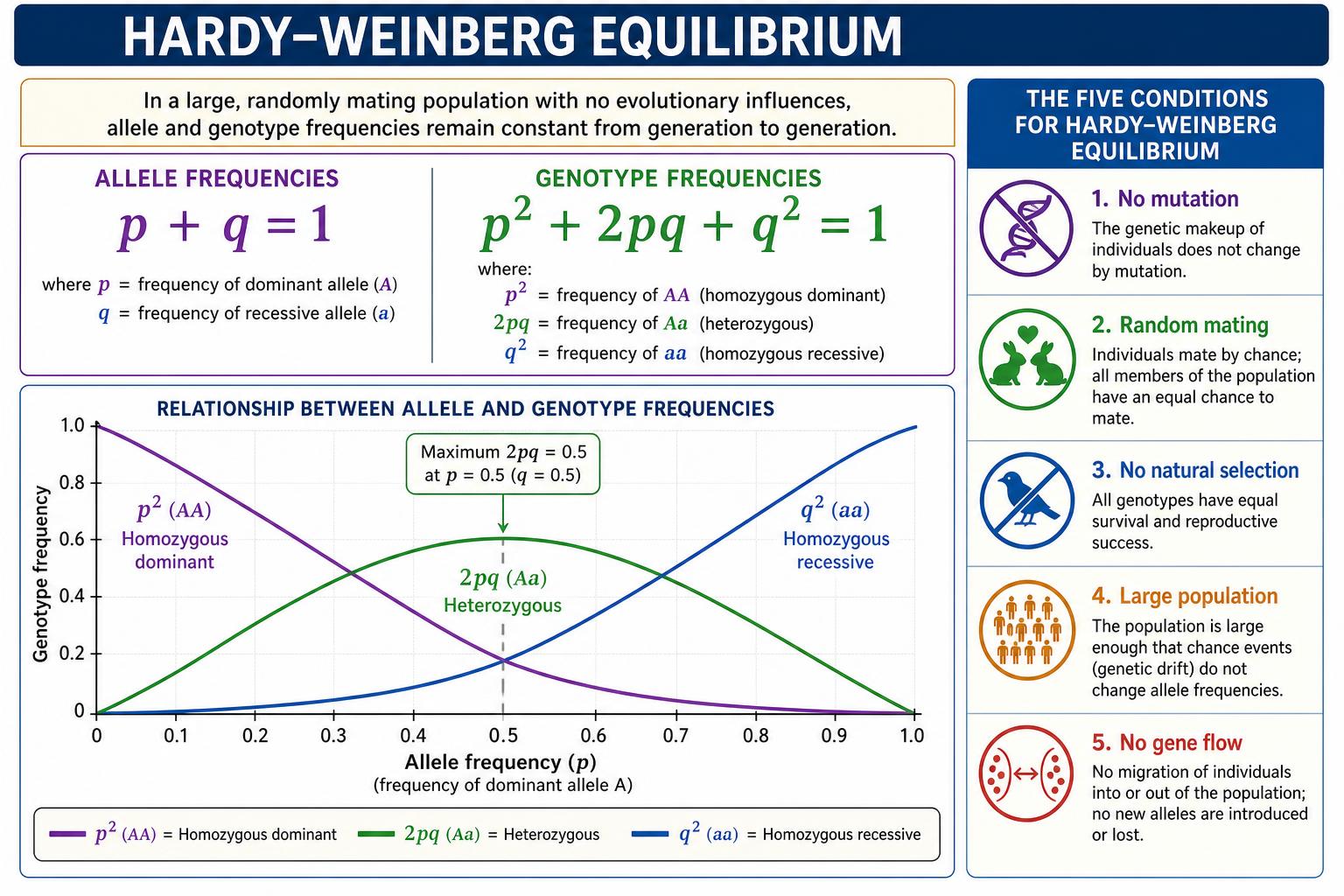
The null model
Hardy-Weinberg describes what would happen if a population WEREN'T evolving. It gives us a baseline so we can detect evolution by spotting deviations. Allele frequencies (p, q) and genotype frequencies (p², 2pq, q²) stay constant generation after generation IF the five assumptions hold.
The five assumptions
- No mutation (allele pool isn't gaining new variants).
- Random mating (no choosing partners based on phenotype).
- No natural selection (all genotypes equally fit).
- Very large population (no genetic drift).
- No gene flow (no migration in or out).
The equations
Allele frequencies: p + q = 1, where p = frequency of dominant allele, q = frequency of recessive allele. Genotype frequencies: p² + 2pq + q² = 1, where p² = homozygous dominant, 2pq = heterozygous, q² = homozygous recessive.
Detecting evolution
Calculate the expected genotype frequencies from p and q. If observed frequencies in the next generation differ significantly, at least one assumption is being violated — evolution is occurring. The job is then to figure out which mechanism (selection, drift, gene flow, etc.) is responsible.
Key terms
Quick definitions to lock in before the exam.