
Mendelian Genetics
Laws of segregation and independent assortment.
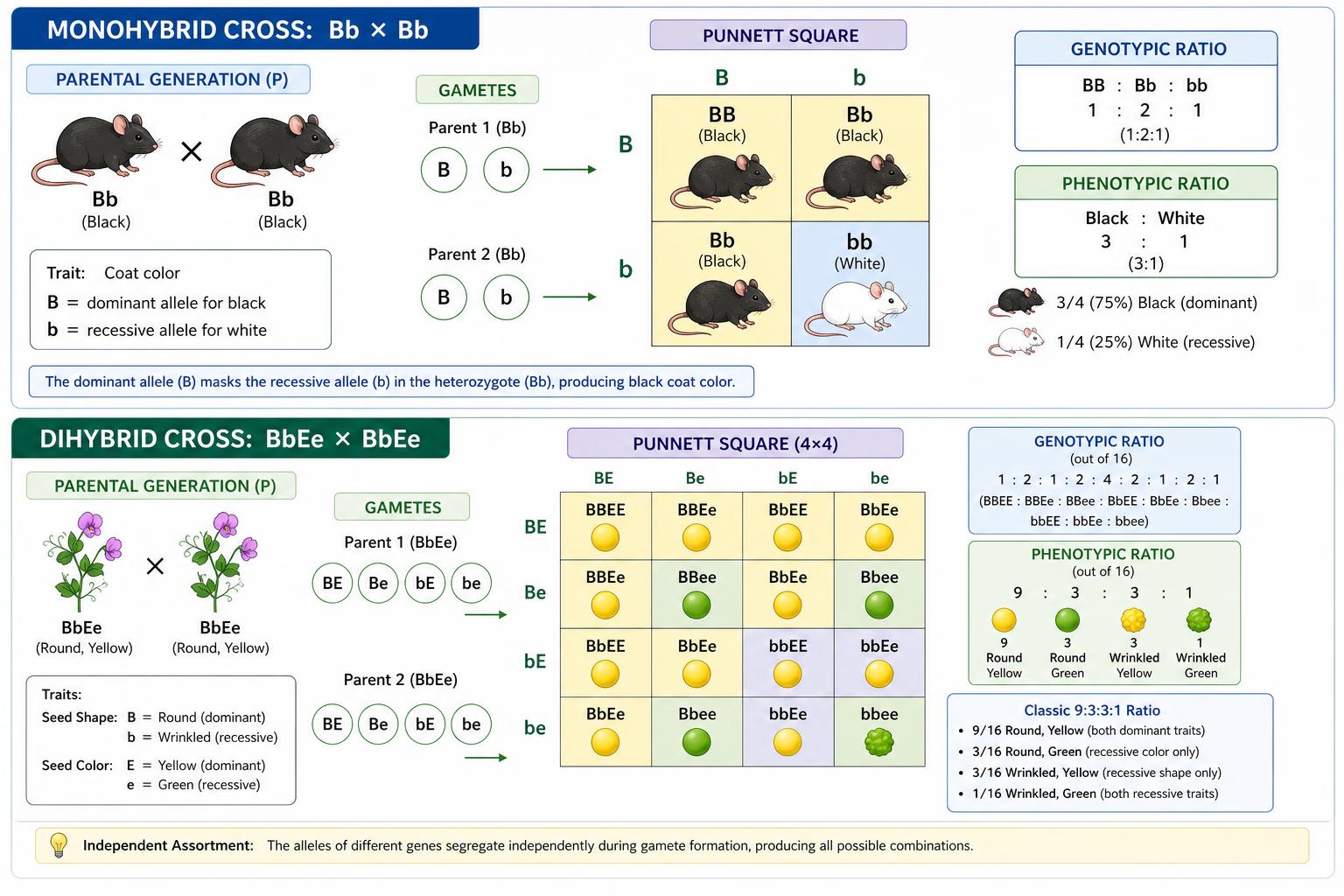
Mendel's two laws
Law of Segregation: each parent has two alleles for a gene, but only one ends up in each gamete (they segregate during meiosis I). The offspring receives one allele from each parent.
Law of Independent Assortment: alleles of different genes (on different chromosomes) segregate into gametes independently of one another. A monohybrid Aa cross gives 3:1 phenotypic ratio; a dihybrid AaBb × AaBb gives 9:3:3:1.
Punnett squares
A Punnett square is a grid that lists possible gametes from each parent on the sides and fills in offspring genotypes inside. It works because each box represents an equally likely fertilization event.
Monohybrid Aa × Aa → 1 AA : 2 Aa : 1 aa (genotypic) → 3 dominant : 1 recessive (phenotypic). Dihybrid AaBb × AaBb → 9:3:3:1 phenotypic ratio.
Test crosses
To determine whether an individual with a dominant phenotype is AA or Aa, cross it with a homozygous recessive (aa). If all offspring are dominant → the unknown is AA. If you see any recessive offspring → the unknown was Aa.
Probability rules
- Product rule: probability of two independent events happening together = P(A) × P(B). 'AND'.
- Sum rule: probability of either of two mutually exclusive events = P(A) + P(B). 'OR'.
- Example: in AaBb × AaBb, P(aabb) = ¼ × ¼ = 1/16.
Chi-square (χ²) test
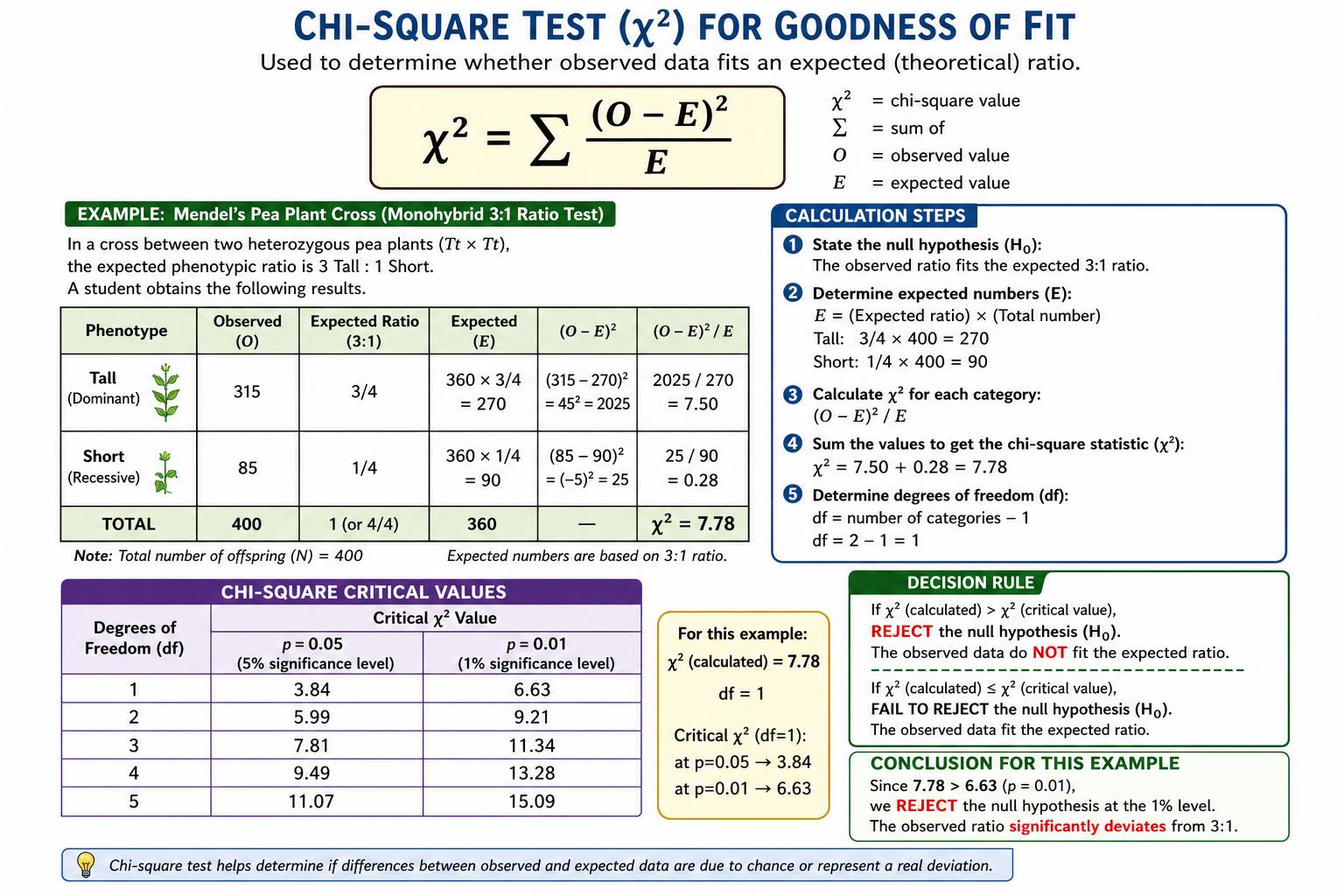
Chi-square asks: are my observed ratios significantly different from what I'd expect by chance? Calculate χ² = Σ (observed – expected)² / expected, then compare to the critical value at df = (categories – 1).
If χ² > critical value (p < 0.05), reject the null hypothesis — the deviation is too big to be due to chance, and something other than your model is going on.
Key terms
Quick definitions to lock in before the exam.