
Meiosis & Genetic Diversity
Two divisions yield 4 haploid gametes with novel combinations.
Why meiosis?
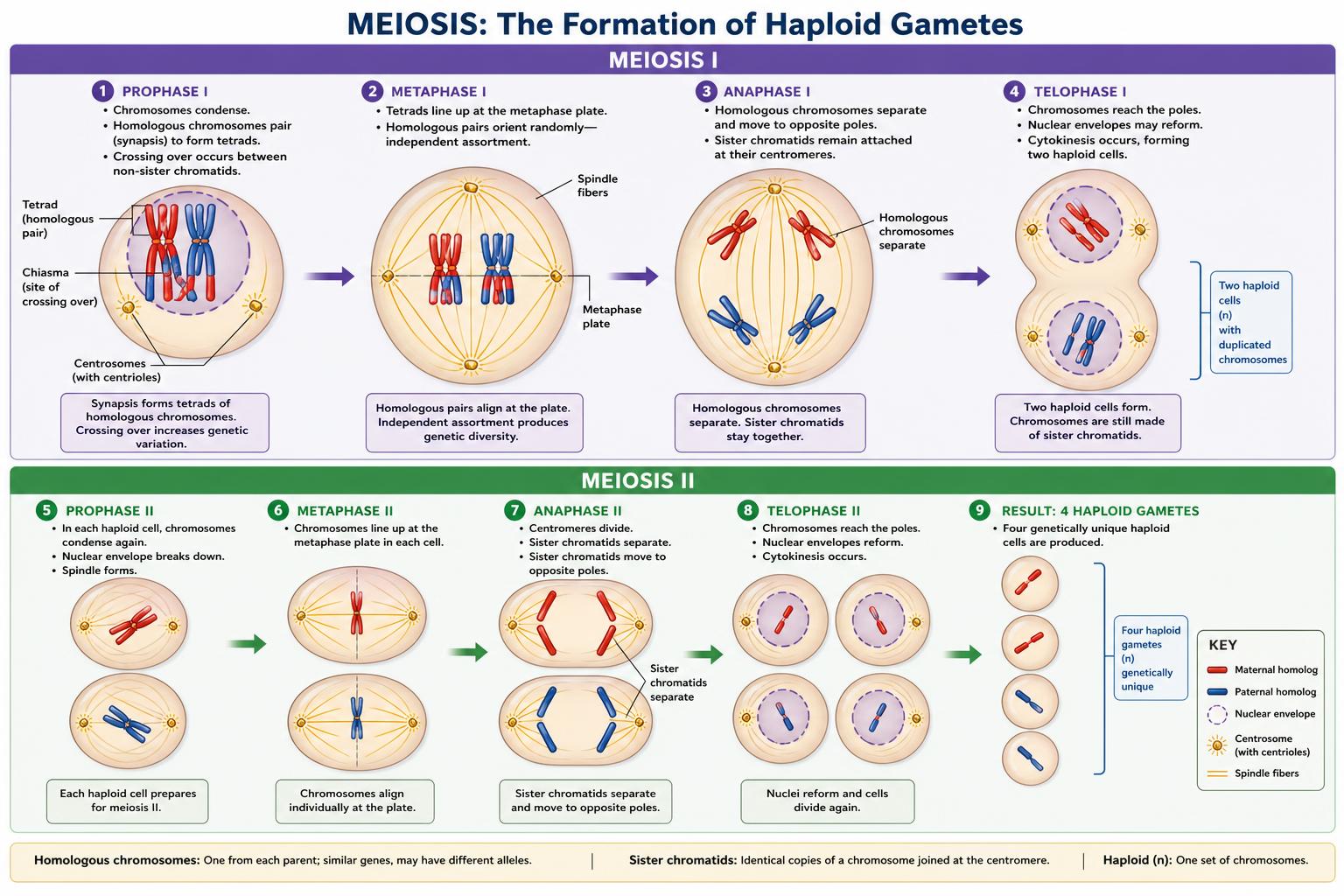
Sexually reproducing organisms need a way to halve the chromosome number when making gametes, so that fertilization restores the diploid count instead of doubling it every generation. Meiosis solves this by performing one round of DNA replication followed by TWO rounds of division.
Starting cell (diploid, 2n) → 4 haploid (n) gametes, each genetically unique.
Meiosis I — homologs separate
The 'reductional' division. After DNA replication in S phase, each chromosome has 2 sister chromatids. In prophase I, homologous chromosomes (one from mom, one from dad) pair up to form tetrads, and crossing over exchanges segments between non-sister chromatids.
At metaphase I, tetrads line up at the metaphase plate. Which homolog faces which pole is independent for every chromosome — this is independent assortment. At anaphase I, homologs separate; sister chromatids stay together. Result: 2 cells, each with n chromosomes (still 2 chromatids each).
Meiosis II — sisters separate
Looks exactly like mitosis, but starts with haploid cells. Sister chromatids line up at the metaphase plate (metaphase II) and separate (anaphase II). Final result: 4 haploid cells, each chromosome now a single chromatid.
Three sources of genetic variation
- Crossing over (prophase I): non-sister chromatids exchange segments → new allele combinations on a single chromosome.
- Independent assortment (metaphase I): each tetrad orients randomly → 2ⁿ possible gamete combinations (n = haploid number; in humans 2²³ ≈ 8.4 million).
- Random fertilization: any sperm can fertilize any egg → another ×8.4M layer of variation.
Mitosis vs. meiosis
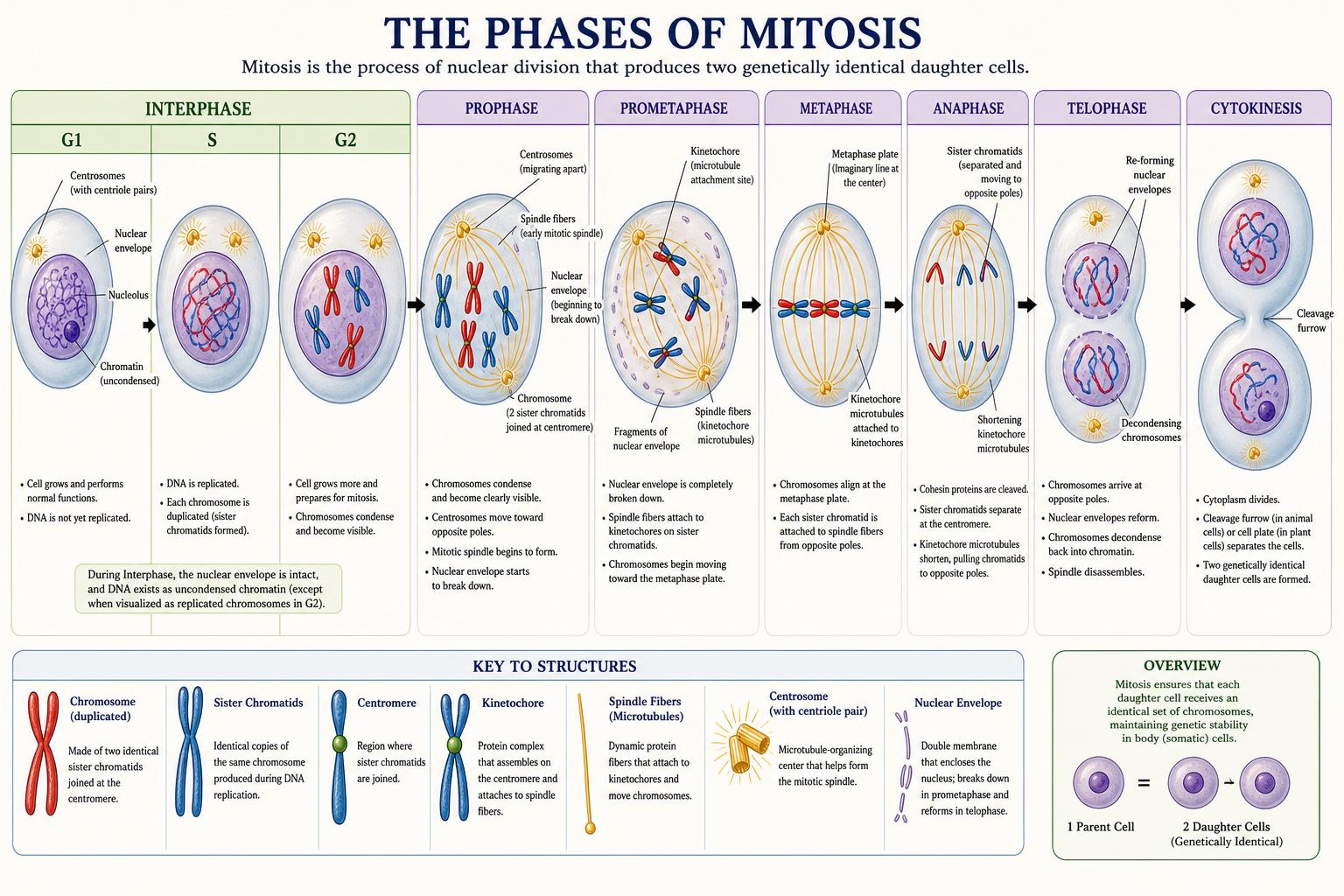
- Mitosis: 1 division, 2 identical diploid daughter cells, no crossing over, no pairing of homologs.
- Meiosis: 2 divisions, 4 unique haploid daughter cells, crossing over and independent assortment, homologs pair in prophase I.
Key terms
Quick definitions to lock in before the exam.