
Behavior & Energy Flow
Behavior responds to stimuli; energy moves through trophic levels.
Animal behavior: innate vs. learned
Innate behaviors are genetically programmed — present from birth and require no experience. Examples: spider web building, salmon spawning migration, fixed action patterns (a goose retrieving a displaced egg). Learned behaviors are modified by experience — imprinting (ducklings following the first moving object they see), classical conditioning, operant conditioning, and insight learning.
Many behaviors are partly innate, partly learned: birds may have an innate template for their species' song but must hear adult birds sing to perfect it.
Communication & cooperation
Animals communicate through chemicals (pheromones), sound (bird calls, whale songs), visual displays, and touch. Cooperative behaviors — pack hunting, alarm calls, kin care, mating displays — often increase the fitness of the group or of relatives sharing the same genes.
Altruism (behavior that costs the actor but helps another) makes evolutionary sense when directed at relatives (kin selection): helping kin survive passes on the same genes the helper carries.
Energy flow through ecosystems
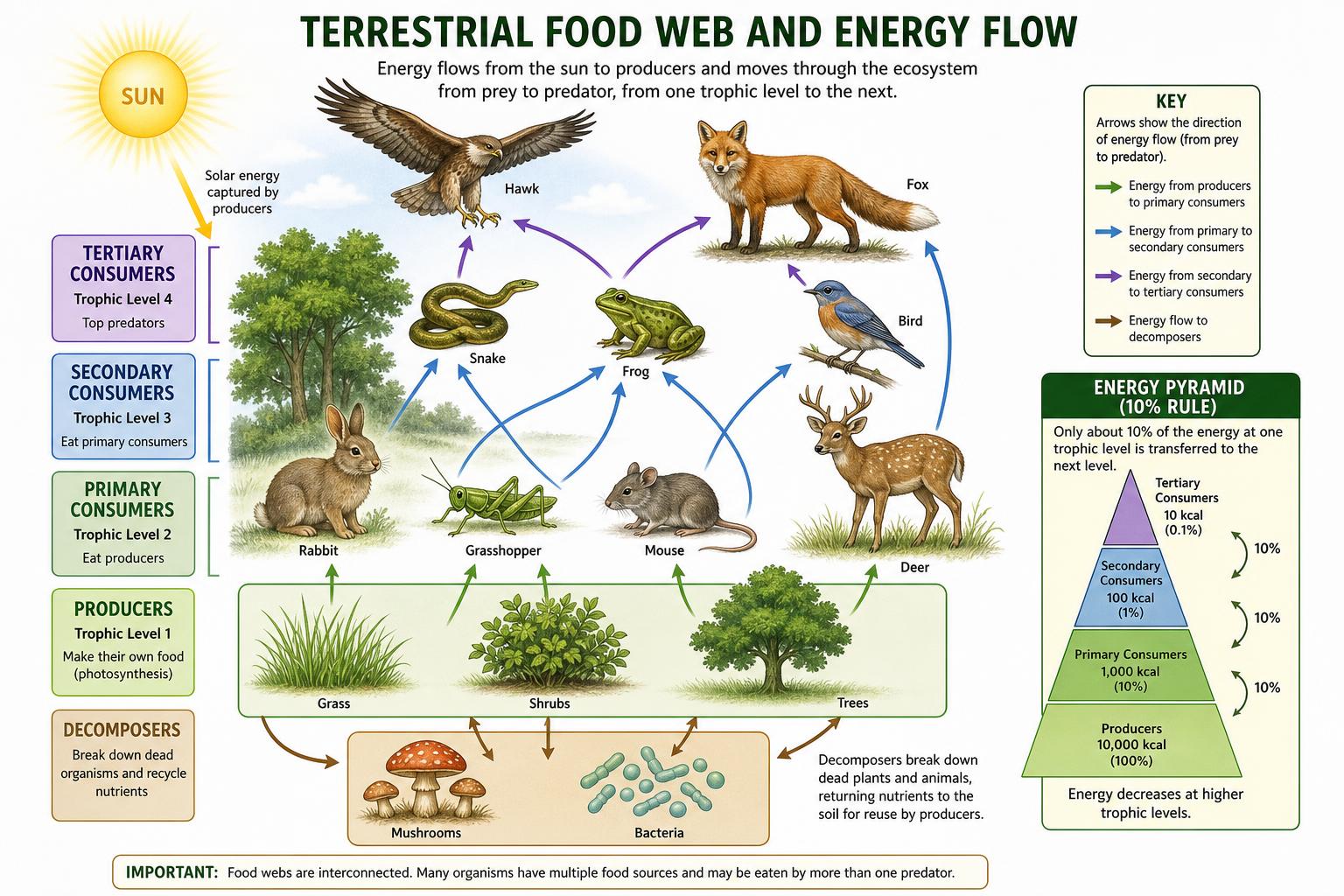
Energy flows in one direction: sun → producers (autotrophs) → primary consumers (herbivores) → secondary consumers (carnivores) → tertiary consumers. Decomposers break down dead matter at every level, returning nutrients to the soil.
Only about 10% of energy at one trophic level becomes biomass at the next (the 10% rule). The rest is lost as heat, used in metabolism, or stuck in indigestible parts. This is why food chains rarely exceed 4–5 levels — there's just not enough energy left.
Productivity & biogeochemical cycles
Gross primary productivity (GPP) is the total energy producers capture via photosynthesis. Net primary productivity (NPP) is what's left after producers' own respiration — this is what's available to consumers. NPP is highest in tropical rainforests and estuaries; lowest in deserts and open ocean.
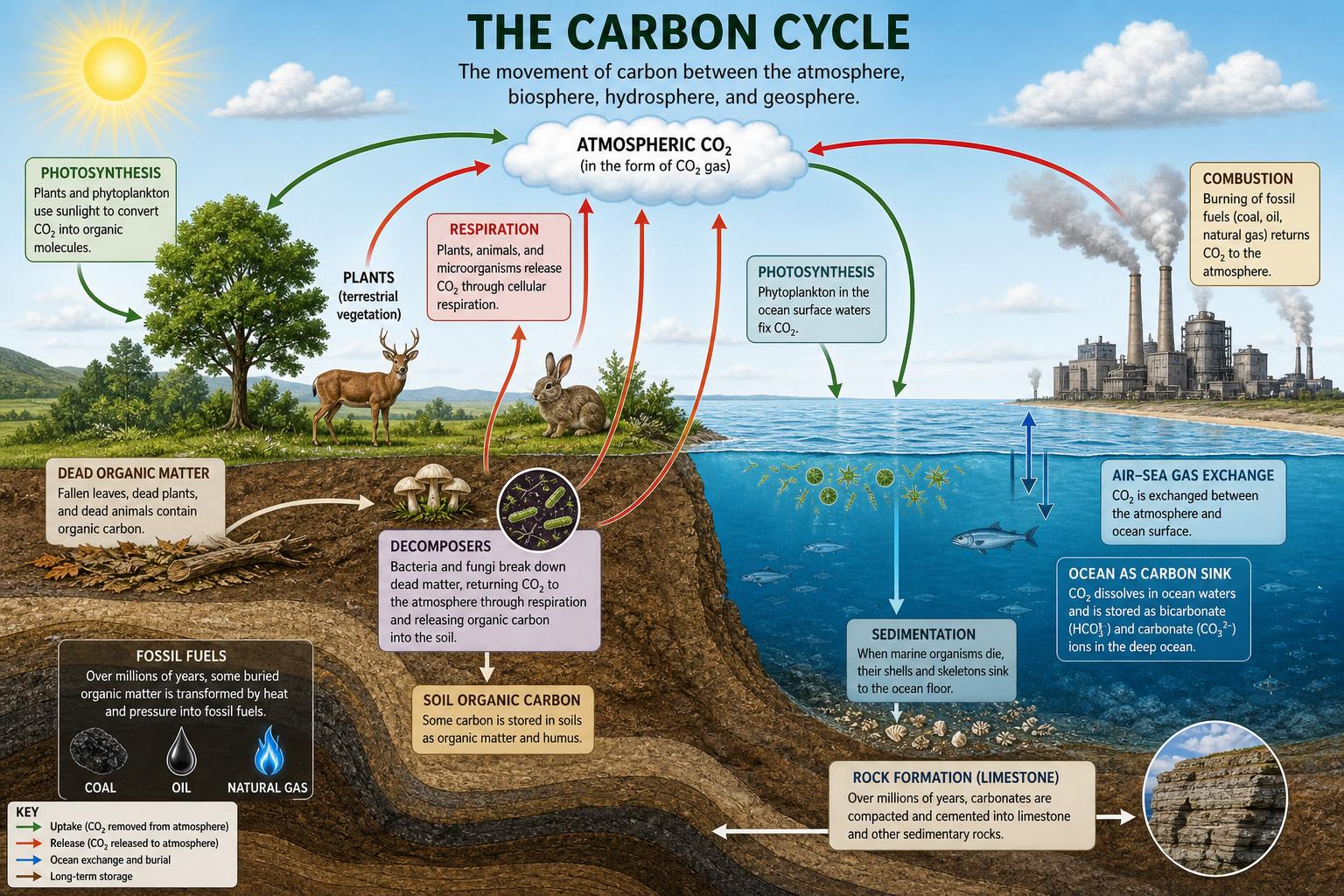
Matter, unlike energy, cycles. Carbon moves between atmosphere (CO₂), biosphere (organic molecules), oceans, and fossil fuels through photosynthesis, respiration, decomposition, and combustion. Nitrogen, phosphorus, and water all have their own cycles.
Key terms
Quick definitions to lock in before the exam.