
Structure of Water & Hydrogen Bonding
Polarity gives water its life-supporting emergent properties.
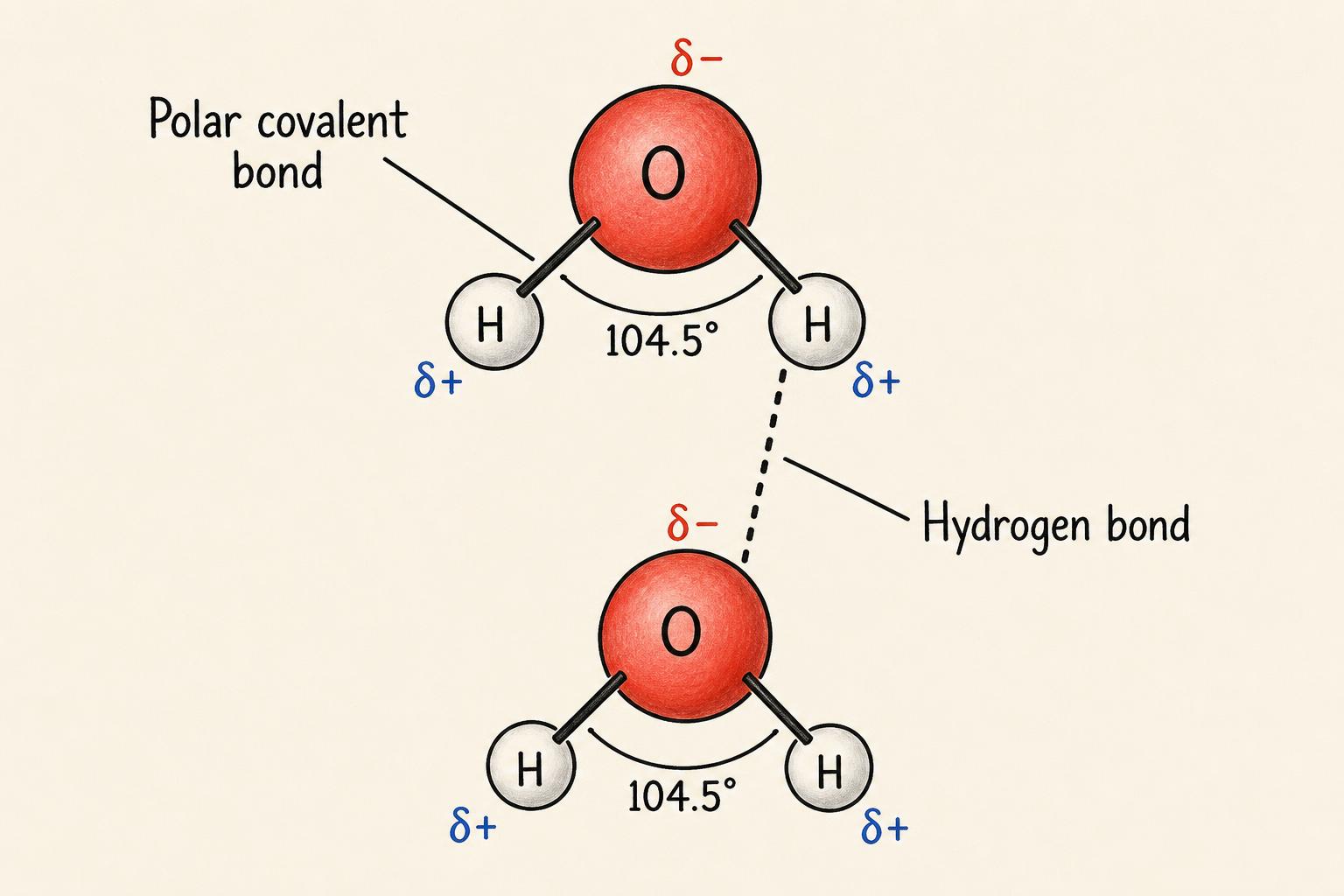
Why water is polar
Oxygen pulls bonding electrons much harder than hydrogen does. Because oxygen is so much more electronegative, the shared electrons in each O–H bond spend more time near the oxygen, giving that end a partial negative charge (δ−) and leaving each hydrogen partially positive (δ+).
The molecule is also bent (~104.5°) rather than linear, so those partial charges don't cancel out. The result is a permanent molecular dipole: the oxygen end carries a partial negative charge, while the hydrogen ends carry partial positive charges.
Hydrogen bonding
Because each water molecule has both a δ− oxygen and δ+ hydrogens, neighboring molecules attract each other: the δ+ H of one is pulled toward the δ− O of another. This attraction is a hydrogen bond.
An individual H-bond is weak (~5% the strength of a covalent bond), but liquid water contains an enormous network of them constantly forming and breaking. That network is what produces water's emergent properties.
Cohesion, adhesion, and surface tension
Cohesion is water sticking to itself. It's why water forms droplets and why a continuous column of water can be pulled up the xylem of a 100-meter tree without breaking.
Adhesion is water sticking to other polar surfaces. Combined with cohesion, it produces capillary action — water creeping up a narrow tube (or up plant tissue) against gravity.
Surface tension comes from cohesion at the air–water interface: water molecules at the surface have fewer neighboring water molecules above them, so the cohesive attractions between the remaining neighbors create a net inward force. This forms a flexible film strong enough to support small insects.
- Transpiration in plants: cohesion + adhesion + tension = the cohesion-tension theory of water transport.
- Surface tension: water striders walk on water; small water bugs trapped at the meniscus.
Temperature properties: specific heat & heat of vaporization
Water resists temperature changes. To warm liquid water, energy must first break some H-bonds before it can speed up the molecules. This high specific heat stabilizes the temperature of cells, oceans, and coastal climates.
Evaporative cooling works the same way in reverse: the highest-energy molecules escape as vapor, taking that energy with them and cooling what's left behind. This is why sweating cools you and why leaves stay below the air temperature on a hot day.
Ice floats — and why that matters
When water freezes, each molecule H-bonds with exactly four others in a rigid, open hexagonal lattice. That lattice spaces the molecules farther apart than they are in liquid water, so ice is less dense than the liquid.
Floating ice insulates the water below, allowing fish and other organisms to survive winter. If ice sank, lakes would freeze solid from the bottom up.
Why water is an excellent biological solvent
Polar water molecules surround ions and polar solutes — δ− oxygens orient toward cations, δ+ hydrogens toward anions — forming hydration shells that pull the solute apart and keep it dissolved. Water dissolves a wide range of ionic and polar substances, which is why it's such an effective biological solvent — but it does not dissolve everything, especially most nonpolar molecules.
Nonpolar substances (oils, fats) can't form these interactions, so they're excluded. This hydrophobic effect is what drives phospholipid bilayers to self-assemble and proteins to fold.
Key terms
Quick definitions to lock in before the exam.