
Cell Signaling
Reception → transduction → response.
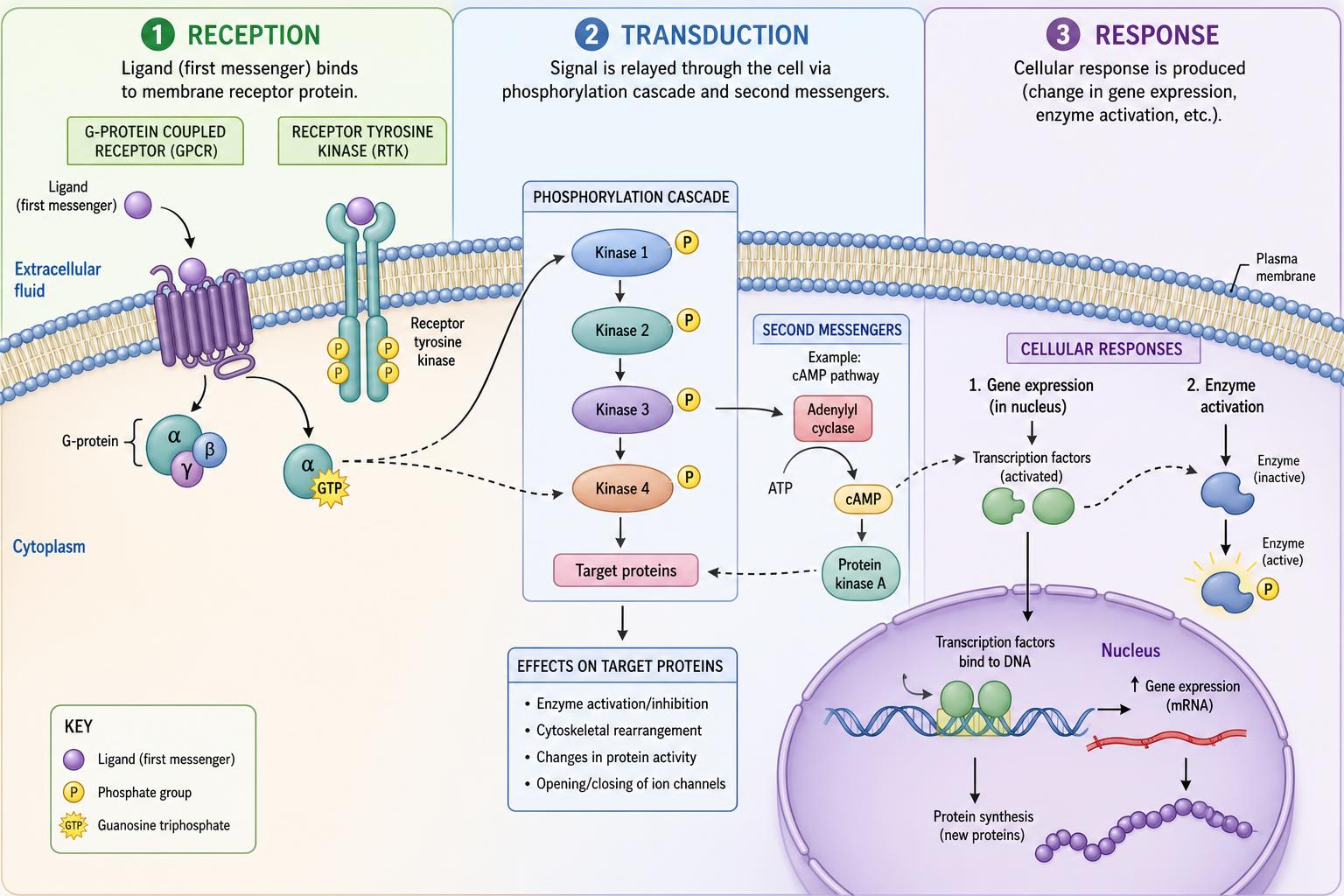
The three stages
Every signaling pathway, no matter how complex, breaks into three stages: reception (signal binds receptor), transduction (signal converted and relayed inside the cell), and response (cellular action — gene expression, enzyme activation, secretion, etc.).
Signal types by distance
- Direct contact: cells touch via gap junctions (animals) or plasmodesmata (plants); also surface molecule–molecule recognition.
- Paracrine: local signal diffuses to nearby cells (growth factors).
- Synaptic: neurotransmitters cross a synaptic cleft (very fast, very local).
- Endocrine: hormones travel through blood to distant target cells (insulin, estrogen).
Receptor types
G-protein-coupled receptors (GPCRs) span the membrane 7 times; ligand binding activates an internal G-protein that triggers downstream cascades. Receptor tyrosine kinases (RTKs) dimerize when ligand binds and phosphorylate each other on tyrosine, starting many parallel pathways. Ligand-gated ion channels open or close on ligand binding (e.g., acetylcholine receptors at the neuromuscular junction).
Intracellular receptors live inside the cell because their ligands (steroid hormones, NO, thyroid hormone) are small/nonpolar enough to cross the membrane. The receptor-ligand complex usually enters the nucleus and acts as a transcription factor.
Transduction: cascades and second messengers
Most pathways amplify the signal through phosphorylation cascades: one activated kinase phosphorylates many target kinases, each of which activates many more. One bound ligand can lead to thousands of activated downstream proteins.
Second messengers like cyclic AMP (cAMP), inositol triphosphate (IP₃), and Ca²⁺ ions diffuse quickly through the cytoplasm and broadcast the signal in all directions.
Response and termination
Responses include opening ion channels, activating enzymes, altering gene expression, or triggering apoptosis. Signaling pathways are normally short-lived: phosphatases remove phosphates, GTPases hydrolyze GTP to GDP, and second messengers are quickly degraded — all to make sure the cell doesn't get stuck in one state.
Key terms
Quick definitions to lock in before the exam.