
Cell Cycle & Regulation
Interphase + mitosis with checkpoints controlled by cyclins/CDKs.
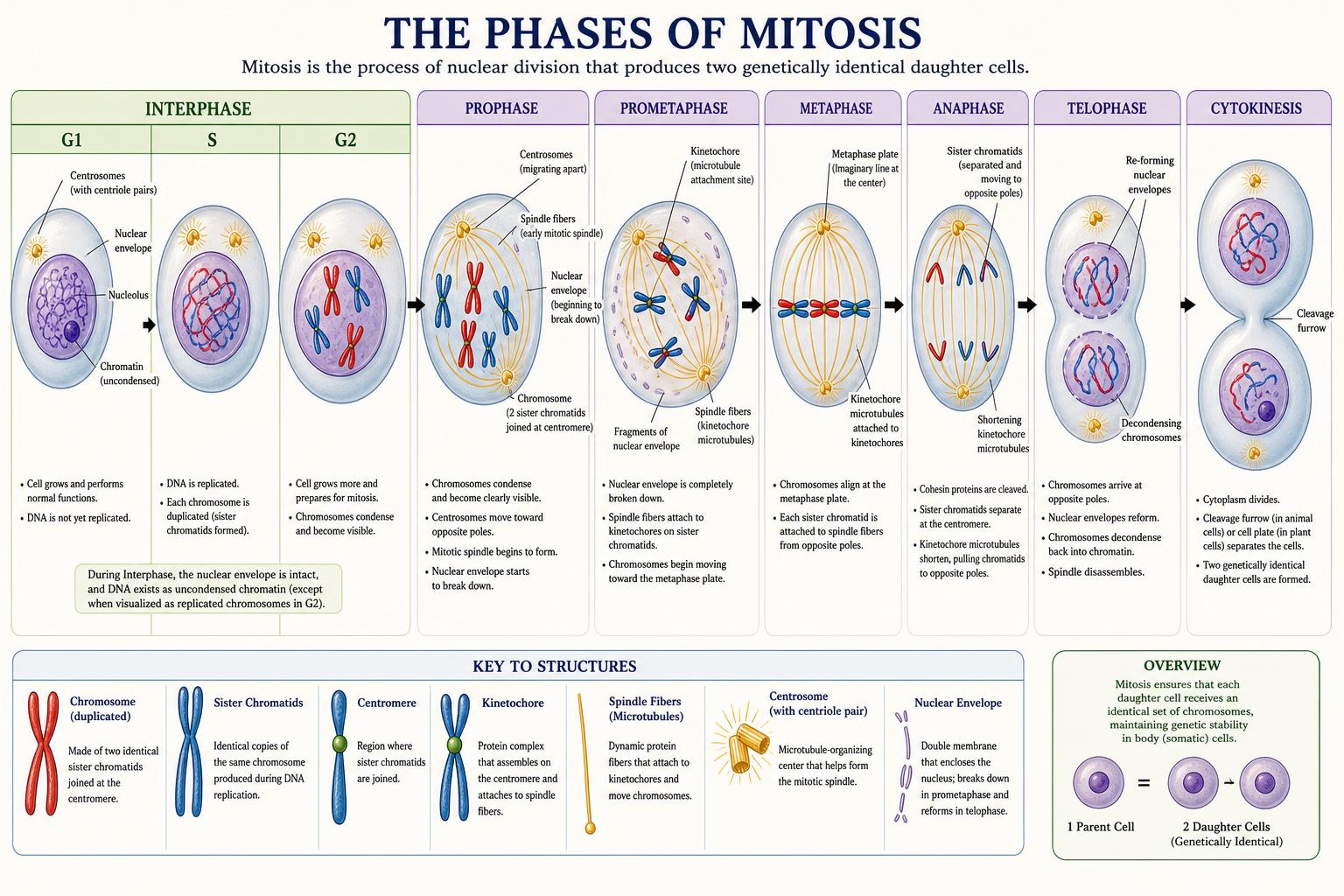
Phases of the cell cycle
The cell cycle has two big parts: interphase (most of the cell's life — G1, S, G2) and M phase (mitosis + cytokinesis).
- G1: cell grows, makes proteins and organelles, decides whether to divide.
- S: DNA replicates; each chromosome now has 2 sister chromatids joined at the centromere.
- G2: more growth, prepares for mitosis, double-checks DNA.
- M: mitosis (PMAT — prophase, metaphase, anaphase, telophase) followed by cytokinesis.
- G0: non-dividing 'rest' state where many specialized cells (neurons, mature muscle) live.
Mitosis step by step
- Prophase: chromosomes condense, nuclear envelope breaks down, spindle forms from centrosomes.
- Metaphase: chromosomes line up along the metaphase plate, each attached to spindle fibers from opposite poles.
- Anaphase: sister chromatids separate and are pulled to opposite poles.
- Telophase: nuclear envelopes reform around the two sets of chromosomes; chromosomes decondense.
- Cytokinesis: cytoplasm splits — cleavage furrow in animals, cell plate in plants — yielding 2 genetically identical daughter cells.
Checkpoints and regulators
Three main checkpoints guard the cycle: G1 (am I big enough? is DNA undamaged? are signals to divide present?), G2 (did DNA replicate correctly?), and M (are all chromosomes attached to spindle fibers?).
Cyclins are regulatory proteins whose levels rise and fall through the cycle. They bind and activate cyclin-dependent kinases (CDKs), which phosphorylate target proteins to advance the cycle. Different cyclin–CDK combos drive different transitions.
Tumor suppressors like p53 ('the guardian of the genome') halt the cycle at G1 if DNA is damaged and trigger repair or apoptosis. Loss-of-function mutations in p53 are found in more than 50% of human cancers.
Apoptosis — programmed cell death
When cells are damaged beyond repair, are no longer needed (e.g., webbing between fetal fingers), or detect infection, they trigger apoptosis — a clean, controlled self-destruction that doesn't cause inflammation. It's an essential complement to cell division for keeping tissues healthy.
Key terms
Quick definitions to lock in before the exam.